Microsoft FrontPage  (also known as Microsoft Office FrontPage) is a discontinued WYSIWYG HTML editor and website administration tool from Microsoft for Windows operating systems. It was branded as part of the Microsoft Office suite from 1997 to 2003. Microsoft FrontPage has since been replaced by Microsoft Expression Web and SharePoint Designer, which were first released in December 2006 alongside Microsoft Office 2007, but these two products were also discontinued in favor of a web-based version of SharePoint Designer, as those three HTML editors were desktop applications.
One of the notable features of FrontPage is its built-in support for automated web templates. The main distinction between these templates and HTML templates generated by other products is that FrontPage templates include an automatic navigation system that creates animated buttons for pages added by the user. It also creates a multi-level navigation system on the fly using the buttons and the structure of the website.
History
FrontPage was initially created by the Cambridge, Massachusetts company Vermeer Technologies, Incorporated, evidence of which can be easily spotted in filenames and directories prefixed _vti_ in websites created using FrontPage.[2] Vermeer was acquired by Microsoft in 1996 specifically so that Microsoft could add FrontPage to its product line-up.
As a WYSIWYG editor, FrontPage is designed to hide the details of pages' HTML code from the user, making it possible for novices to easily create web pages and sites.
FrontPage's initial outing under the Microsoft name came in 1996 with the release of Windows NT 4.0 Server and its constituent HTTPd server Internet Information Services 2.0. Bundled on CD with the NT 4.0 Server release, FrontPage 1.1 would run under NT 4.0 (Server or Workstation) or Windows 95, and was aimed at providing server administrators with a tool to deliver rich web and intranet content in a package as easy to use as Microsoft Word.
FrontPage used to require a set of server-side plugins originally known as IIS Extensions. The extension set was significantly enhanced for Microsoft's inclusion of FrontPage into the Microsoft Office line-up with the 97 release and subsequently renamed FrontPage Server Extensions (FPSE). Both sets of extensions needed to be installed on the target web server for its content and publishing features to work. Microsoft offered both Windows and Unix-based versions of FPSE. However, newer versions of FrontPage also support the standard WebDAV protocol for remote web publishing and authoring.
A version for Mac OS was included in the rare "Gold Edition" of Microsoft Office 98 Macintosh Edition. However, it had fewer features than the Windows product and Microsoft did not update it since.
In 2006, Microsoft announced that FrontPage would eventually be superseded by two products.[3] Microsoft SharePoint Designer will allow business professionals to design SharePoint-based applications. Microsoft Expression Web is targeted at the web design professional for the creation of feature-rich websites. Microsoft discontinued Microsoft FrontPage in December 2006.
Features
Some features that are part of the last version of FrontPage include:
- Help navigating through your site, and seeing your file structure, visually
- Built-in features for HTML, CSS, and Java / JavaScript (partial)
- Built in image editor (MS Image Composer)
- Point-and-click functionality for common tools, like mouseovers, e-mail forms, and hit counts
- Simple to use with previous knowledge of Office products
- Integrated data display with Office products like Access and Excel
- Support for CSS-based themes (like ASP.NET master pages)
- When you change the URL of a page, all the links to that page are dynamically changed
- Task-assignment for team projects
- Content is editable from anywhere with FrontPage (password is needed)
- Support for rich clipboard data import (i.e. copy/pasting data from Internet Explorer into FrontPage 2003 will automatically download media resources such as images and save them locally)
Criticism
Some criticisms of FrontPage include:
- In previous versions, the WYSIWYG mode tended to generate non-validating HTML, resulting in pages that were optimized for Internet Explorer. However, FrontPage 2003 is capable of generating valid XHTML if the author requires it.
- In some cases, HTML that is manually changed in FrontPage's code view can revert back to incorrectly generated markup after making even slight changes in WYSIWYG mode.
- Because of the way it manages content as live resources, FrontPage is generally not well suited for administering medium to large corporate websites.
Versions
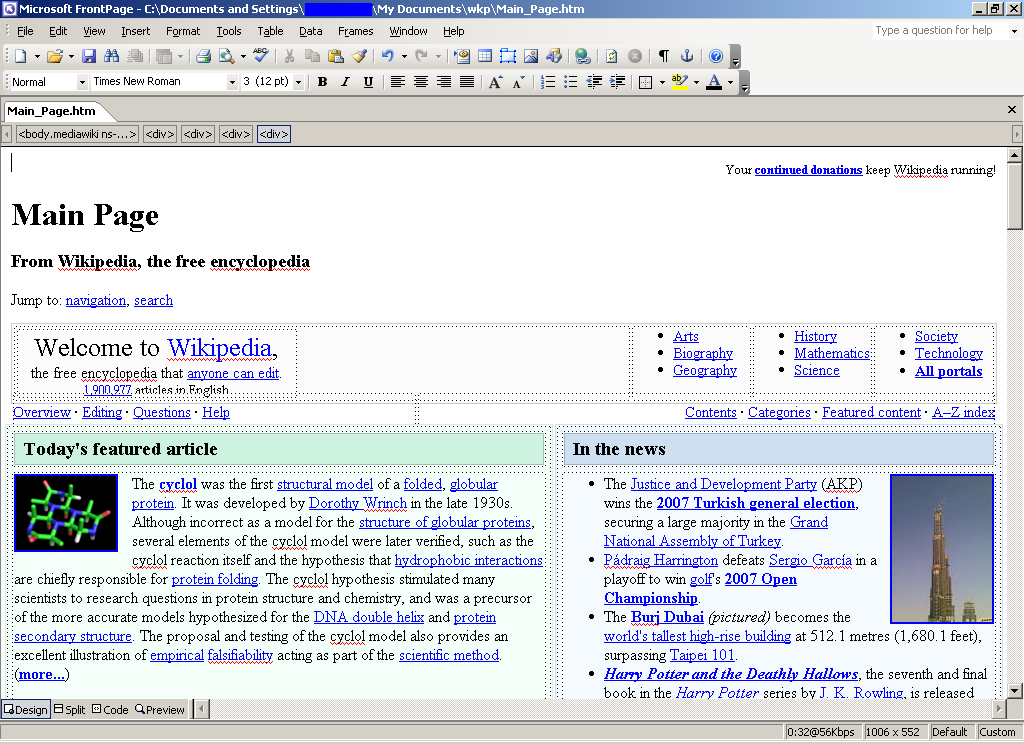

Microsoft FrontPage 2003
The final version of FrontPage is Microsoft Office FrontPage 2003. The company has introduced two new products to replace FrontPage called Microsoft Expression Web and Microsoft SharePoint Designer. Previous versions include:
- 1995-11 Vermeer FrontPage 1.0
- 1996-06 Microsoft FrontPage 1.1
- 1996-10 Microsoft FrontPage 97 (version 2)
- 1997-?? Microsoft FrontPage Express 2.0 (free stripped-down version came with Internet Explorer, and could be found online from numerous "download" repositories[4][5]
- 1997-12 Microsoft FrontPage 98 (version 3)
- 1998-?? Microsoft FrontPage for Macintosh 1.0
- 1999-03 Microsoft FrontPage 2000 (version 4) included in some Office 2000 editions
- 2001-06 Microsoft FrontPage 2002 (version 10)
- 2003-10 Microsoft Office FrontPage 2003 (version 11)
- Note: There is no "official" version 5 to 9, because after FrontPage was included with Microsoft Office, the FrontPage version numbers followed their Office version numbers. Nonetheless, version numbers may appear in the meta tags of HTML code generated by these versions of FrontPage.
References
- ↑ "How to check the version of Office 2003 products". Microsoft. Archived from the original on October 13, 2004.
- ↑ Vermeer Technologies Gives Birth To FrontPage by Jay Milne, Network Computing. 1995-11-01. Archived 1999-10-02.
- ↑ The Future of FrontPage, Microsoft. 2006-04-27. Archived 2006-06-26.
External links
- Microsoft FrontPage at Microsoft (archived 1996-10-27, 2004-08-24)
- FrontPage History - Version Releases and Vermeer FrontPage Timeline at SEO Consultants (archived 2006-02-09)
- Microsoft FrontPage at Wikipedia
 |
Wikipedia
|
|---|