 |
Stub
This article is a stub, an article too short to provide more than rudimentary information about a subject. You can help the Microsoft Wiki by expanding it.
|
|---|
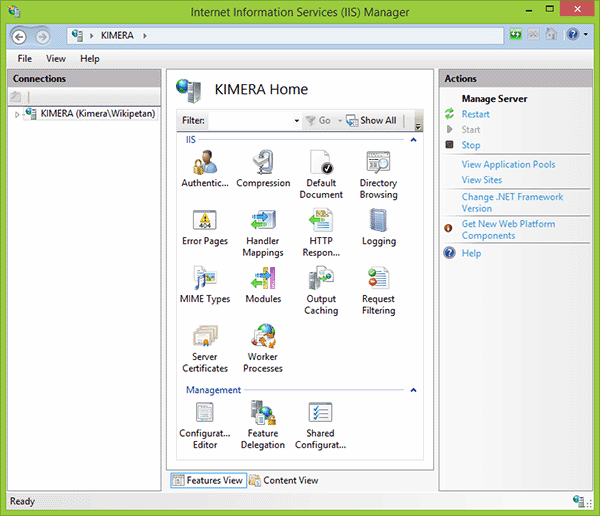

Screenshot of IIS Manager console of Internet Information Services 8.5
Microsoft IIS (Internet Information Services, IIS, 2S) is an extensible web server created by Microsoft for use with the Windows NT family. IIS supports HTTP, HTTP/2, HTTP/3, HTTPS, FTP, FTPS, SMTP, and NNTP. It has been an integral part of the Windows NT family since Windows NT 4.0, though it is absent from some editions (e.g., Windows XP Home edition), and is not active by default. A dedicated suite of software called SEO Toolkit is included in the latest version of the manager, and has several tools for SEO with features for metatag/web coding optimization, sitemaps, robots.txt configuration, website analysis, crawler setting, SSL server-side configuration, and more.
History
![[icon]](https://static.wikia.nocookie.net/windows/images/3/31/Wiki_letter_w_cropped.png/revision/latest?cb=20151108163730) | This section requires expansion. |
The first Microsoft web server was a research project at the European Microsoft Windows NT Academic Centre (EMWAC), part of the University of Edinburgh in Scotland, and was distributed as freeware. However, since the EMWAC server was unable to handle the volume of traffic going to microsoft.com, Microsoft was forced to develop its own web server, IIS.
Almost every version of IIS was released either alongside or with a version of Microsoft Windows:
- IIS 1.0 was initially released as a free add-on for Windows NT 3.51.
- IIS 2.0 was included with Windows NT 4.0.
- IIS 3.0, which was included with Windows NT 4.0 Service Pack 2, introduced the Active Server Pages dynamic scripting environment.
- IIS 4.0 was released as part of the "Option Pack" for Windows NT 4.0. It introduced the new MMC-based administration application and was also the first version where multiple instances of web and FTP servers could run, differentiating them by port number and/or hostname. It was also the first version to run application pools.
- IIS 5.0 shipped with Windows 2000, and introduced additional authentication methods, support for the WebDAV protocol, and enhancements to ASP. IIS 5.0 also dropped support for the Gopher protocol and added HTTP.SYS.
- IIS 5.1 was shipped with Windows XP Professional and was nearly identical to IIS 5.0 on Windows 2000.
- IIS 6.0, included with Windows Server 2003 and Windows XP Professional x64 Edition, added support for IPv6 and included a new worker process model that increased security as well as reliability. HTTP.sys was introduced in IIS 6.0 as an HTTP-specific protocol listener for HTTP requests. Also, each component (like Server Side Includes or ASP, for example) now has to be explicitly installed because in earlier versions hackers often entered sites by using security bugs of components that were not even used by the hacked site, improving security.
- IIS 7.0 was a complete redesign and rewrite of IIS and was shipped with Windows Vista and Windows Server 2008. It included a new modular design that allowed for a reduced attack surface and increased performance. It also introduced a hierarchical configuration system allowing for simpler site deploys, a new Windows Forms-based management application, new command-line management options, and increased support for the .NET Framework. IIS 7.0 on Vista does not limit the number of allowed connections as IIS on XP did, but limits concurrent requests to 10 (Windows Vista Ultimate, Business, and Enterprise editions) or 3 (Vista Home Premium). Additional requests are queued, which hampers performance, but they are not rejected as with XP.
- IIS 7.5 was included with Windows 7 (but it must be turned on in the side panel of Programs and Features) and Windows Server 2008 R2. It improved WebDAV and FTP modules as well as command-line administration in PowerShell. It also introduces TLS 1.1 and TLS 1.2 support, the Best Practices Analyzer tool, and process isolation for application pools.
- IIS 8.0 is only available in Windows Server 2012 and Windows 8. It includes Server Name Indication (binding SSL to hostnames rather than IP addresses), Application Initialization, centralized SSL certificate support, and multicore scaling on NUMA hardware, among other new features.
- IIS 8.5 is included in Windows Server 2012 R2 and Windows 8.1. This version includes Idle worker-Process page-out, Dynamic Site Activation, Enhanced Logging, ETW logging, and Automatic Certificate Rebind.
- IIS 10.0 version 1607 is included in Windows Server 2016 and Windows 10 version 1607. This version includes support for HTTP/2, running IIS in Windows containers on Nano Server, a new Rest management API and corresponding web-based management GUI, and Wildcard Host Headers.
- IIS 10.0 version 1709 is included in Windows Server 2016 version 1709 and Windows 10 version 1709. This version adds support for HTTP Strict Transport Security (HSTS), container enhancements, new site binding PowerShell cmdlets, and 4 new server variables prefixed with "CRYPT_".
- IIS 10.0 version 1809 is included in Windows Server 2019 and Windows 10 October Update. It adds flags for control of HTTP/2 and OCSP Stapling per site, a compression API, and an implementing module supporting both gzip and brotli schemes, and a UI for configuring HSTS.
- IIS 10.0 on Windows 11 and Windows Server 2022 has native support for HTTP/3.
All versions of IIS before 7.0 running on client operating systems supported only 10 simultaneous connections and a single website.
Features
| This section requires expansion. |
Usage
| This section requires expansion. |
Security
| This section requires expansion. |
See also
- Microsoft Personal Web Server
- Windows Activation Services