 |
Cleanup
To meet the Microsoft Wiki's quality standards, this article or section may require cleanup. Please help by improving the article.
|
|---|
Microsoft Security Essentials (MSE) is a discontinued free antivirus software (AV) product made by Microsoft for use on Microsoft Windows. It provides protection against different types of malware, such as computer viruses, spyware, rootkits, and trojan horses.
Microsoft Security Essentials was distributed on Microsoft’s website for download on Windows Vista and Windows 7. These versions of Windows include Windows Defender, which is intended mainly for detecting spyware and adware, and is not considered to be a full antivirus solution by the Action Center. Prior to version 4.5, Microsoft Security Essentials ran on Windows XP as well.
Unlike the Microsoft Forefront family of enterprise-oriented security products, Microsoft Security Essentials is geared for consumer use. The license agreement allows home users and small businesses to install and use the product free of charge. Microsoft Security Essentials replaces Windows Live OneCare, a discontinued commercial subscription-based antivirus service.
Microsoft Security Essentials received positive reviews upon its release for being a free, official anti-malware solution for Windows. However, its effectiveness has been doubted by some reviewers in comparison with some paid anti-malware products.
The features of Microsoft Security Essentials were rolled into Windows Defender (later known as Microsoft Defender) starting with Windows 8, making the latter a full, built-in anti-malware product. As such, Microsoft Security Essentials cannot be installed on Windows 8 and later versions of Windows.
Development
Microsoft announced plans for a free consumer security product, codenamed Morro, on November 18, 2008.[4] It marked a change in Microsoft's consumer antivirus marketing strategy: Instead of offering a subscription-based antivirus with a host of other tools, such as backup and a personal firewall, Morro would be free for all genuine installations of Windows not intended for business use (with an exception for small home based businesses) and offers protection against all types of malware.[5] Microsoft Forefront would be offered alongside Microsoft Security Essentials, with central management tools not present in the latter.
On June 23, 2009, Microsoft opened a public beta to 75,000 people in the United States, Israel, the People's Republic of China, and Brazil. At the time, Microsoft stated that Microsoft Security Essentials would be finalized and released before the end of 2009, in 20 markets and 10 languages.[6] The final build was released on September 29, 2009.[7][8]
Hardware requirements for Microsoft Security Essentials differ, depending on the operating system. For Windows XP, it requires at least a 500 MHz processor and 256 MB of RAM. On Windows Vista and Windows 7, it requires a 1 GHz processor and 1 GB of RAM. Under any compatible operating system, a VGA screen of 800 × 600 or higher, 140 MB of free space, and an Internet connection are also required.[9]
On July 19, 2010, Microsoft released the beta version of Microsoft Security Essentials 2.0. The key new features are an updated protection engine, protection against web-based threats, and a network intrusion detection system that works on Windows Vista and Windows 7.[10][11]
Features
Microsoft Security Essentials automatically checked and downloaded the latest virus definitions from Windows Update, which was updated three times a day. Users may alternatively download the updates manually from the Microsoft Security Portal website. On September 30, 2011, a faulty definition update caused the product to incorrectly tag Google Chrome as malware; the issue was resolved within three hours. MSE originally ran on Windows XP, Windows Vista, and Windows 7, although versions 4.5 and later do not run on Windows XP, and Microsoft stopped producing automatic definition updates for Windows XP on July 14, 2015 (however, manual definition updates are still availabel for Windows XP users who run older versions of MSE).
MSE was built upon the same foundation as other Microsoft security products; they all use the same anti-malware engine known as Microsoft Malware Protection Engine (MSMPENG) and virus definitions. It does not have the personal firewall component of OneCare and the centralized management features of Forefront Endpoint Protection.
MSE provided real-time protection, constantly monitoring activities on the computer, scanning new files as they were created or downloaded from the Internet. It quarantines detected threats and prompts for user input on how to deal with them. If no response is received within ten minutes, suspected threats are handled according to the default actions defined in the application's settings. Depending on those settings, it may also create System Restore checkpoints before removing the detected malware. As a part of real-time protection, MSE reports all suspicious behaviors of monitored programs to Microsoft Active Protection Service (MAPS, formerly Microsoft SpyNet) by default. If the report matches a newly discovered malware threat with an unreleased virus definition, the new definition will be downloaded to remove the threat.
Hardware requirements for the product depended on the operating system; on a computer running Windows Vista or Windows 7, it requires a 1 GHz processor, 1 GB of RAM, a computer monitor with a display resolution of at least 800 × 600 pixels, 200 MB of free hard disk space, and a stable Internet connection.
Licensing scheme
Microsoft allows users to freely download, install and use Microsoft Security Essentials on an unlimited number of their computers in their households, so long as each computer has a genuine copy of Microsoft Windows. Microsoft Security Essentials checks for validity of the operating system during and after installation. If the operating system is found to be not genuine, Microsoft Security Essentials will notify the user of the issue, and may cease to operate after a period of time.[3]
Microsoft Security Essentials software license agreements also denies the user the right to reverse-engineer, hack, decompile or disassemble the software or to publish or disclose the results of benchmark tests of this software to third parties without prior written approval from Microsoft Corporation.[3]
Reception
Industry response
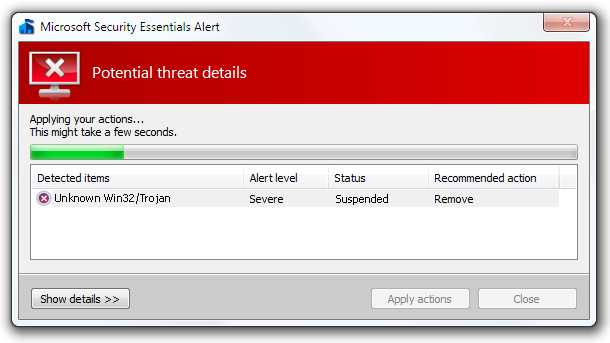

Microsoft Security Essentials scanning an Unknown Win32/Trojan virus file.
On November 19, 2008, after Microsoft publicly announced Microsoft Security Essentials under the code-name "Morro", Symantec and McAfee shares fell 9.44 percent and 6.62 percent, respectively. Microsoft shares also fell 6 percent. Amy Barzdukas, senior director of product management for the Online Services and Windows Division at Microsoft announced that Microsoft Security Essentials will not directly compete with other paid-for antivirus software; rather it was "focused on the 50 to 60 percent [of PC users] who don't have, or won't pay for, antivirus protection, antimalware protection".[12]
Symantec, McAfee, and Kaspersky Lab, three competing antivirus vendors, dismissed Microsoft Security Essentials as a competitor, claiming that Microsoft Security Essentials is not as good as their own software.[13][14] Tom Powledge of Symantec claimed OneCare offered "substandard protection" and an "inferior user experience", implying Microsoft Security Essentials would be the same.[citation needed] Joris Evers, director of worldwide public relations for McAfee stated "With OneCare's market share of less than 2%, we understand Microsoft's decision to shift attention to their core business."[15] Justin Priestley of Kaspersky stated, "[Microsoft] continued to hold a very low market share in the consumer market, and we don't expect the exit of OneCare to change the playing field drastically."[15]
AVG Technologies, however, viewed MSE positively. An AVG Technologies representative stated, "We view this as a positive step for the AV landscape. AVG has believed in the right to free antivirus software for the past eight years." Nevertheless, AVG raised the issue of distributing the software: "Microsoft will have to do more than simply make the product available."[15]
Despite its appreciation of Microsoft Security Essentials as a free product, AVG Technologies stated that integration of Microsoft Security Essentials with Microsoft Windows would be a violation of competition law.[16] McAfee and Sophos both affirmed that an antitrust lawsuit would surely have followed if Microsoft had bundled Microsoft Security Essentials with Windows.[17]
On June 10, 2009, Microsoft announced that a beta version of Microsoft Security Essentials would be released in the near future, but did not specify a date; subsequently, Microsoft shares grew by 2.1 percent. Both Symantec and McAfee shares fell by 0.5 percent and 1.3 percent, respectively. Daniel Ives, an analyst with FBR Capital Markets, said Microsoft Security Essentials would be a "long-term competitive threat", though near-term impact would be negligible.
Reviews
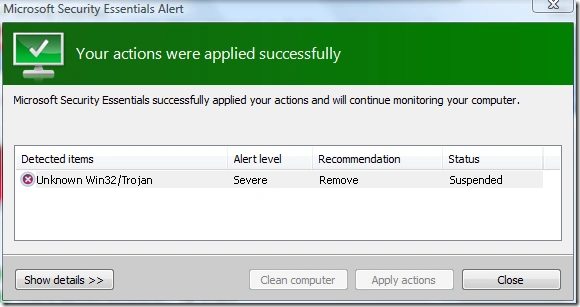

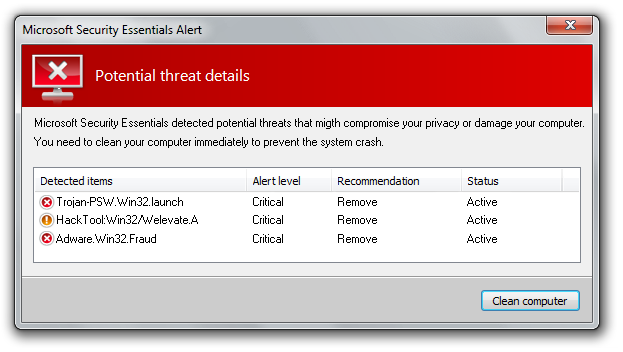

Microsoft Security Essentials seen in Online scan.
The public beta received several positive reviews, citing its low resource usage, straightforward user interface, and price point.[18][19][20][21] Brian Krebs of The Washington Post found Microsoft Security Essentials used only 4 megabytes of RAM during testing, even during scans. A "quick scan" took about 10 minutes, and a "full scan" about 45 minutes on an installation of Windows 7.[20]
Ars Technica reviewed it positively, citing its organized interface, low resource usage, and its status as freeware.[22]
PC World noted its "clear-cut" and "cleanly designed" tabbed user interface. At the top of the main tab, the security status is clearly shown. The other three tabs allow users to manually update Microsoft Security Essentials, review its history, and change program settings. However, PC World found some of the settings to be cryptic and confusing. Settings, such as what to do when malware is found, default to "Microsoft Security Essentials' recommended action". There is no explanation of the recommended action except in the help file. The editor was also confused because Microsoft Security Essentials does not mention it automatically updates itself within the interface; some may believe they must manually update MSE through the "Update" tab.[19] However, this was included in the final release.
PC Magazine cited MSE's small installation package (about 7 MB, depending on the operating system) and its speedy installation. On the downside, the full installation occupied about 110 MB of disk space, and the initial update took 5 to 15 minutes. The editor also noted the fact that MSE sets Windows Update into its fully automatic mode, which automatically downloads and installs updates, although it can then be turned off again through the control panel. Installation succeeded on 12 malware-infected systems. Some full scans took over an hour on infected systems; however, a scan on a clean system took 35 minutes.[18]
According to Neil Rubenking, a PC Magazine author, in an on-demand scan test that he conducted, Microsoft Security Essentials Beta found 89 percent of all malware samples: It found only 30 percent of commercial keyloggers, 67 percent of rootkits and only half of scareware samples. The suite's real-time protection found 83 percent of all malware samples and blocked the majority of them. In this test, Microsoft Security Essentials found 40 percent of the commercial keyloggers and 78 percent of the rootkits.[18]
The official release of Microsoft Security Essentials, however, fared better in AV-Test.org test: It detected and caught 98.44 percent of 545,034 computer viruses, computer worms, and software Trojan horses, as well as 90.95 percent of 14,222 spyware and adware samples. It also detected and eliminated all 25 tested rootkits. It generated no false positives at all.[23]
On January 7, 2010, Microsoft Security Essentials won the PC Advisor's Best Free Software award.[24] In December that same year, it secured the Bronze award from AV-Comparatives for proactive detection of 55 percent of new or unknown malware, the Silver award for low false positives (six occurrences), and the Bronze award for overall performance.
Impersonation by malware
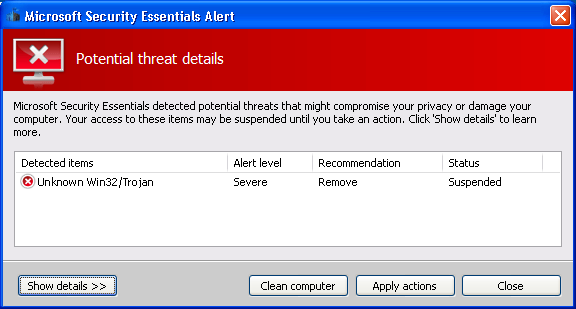

The fake Microsoft Security Essentials Alert.
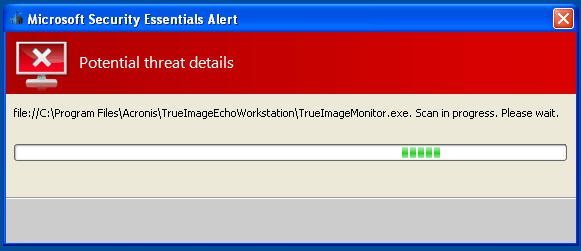

MSEA scanning some infected files needed to be removed from the PC.
The popularity of Microsoft Security Essentials has led to the appearance of malware abusing its name. In February 2010, a rogue security package calling itself "Security Essentials 2010" appeared on the Internet. Designated TrojanDownloader:Win32/Fakeinit by Microsoft, it bears no visual resemblance to the Microsoft product but the legitimate and fake versions are aligned differently.[25][26] It reappeared in November 2010, this time calling itself "Microsoft Security Essentials 2011".[27] A more dangerous rogue appeared in October 2010. Designated Rogue:Win32/FakePAV or Unknown Win32/Trojan, it closely resembles Microsoft Security Essentials and uses sophisticated social engineering to deceive users and infect their systems, under the guise of five different fictional anti-malware products. It also terminates and prevents the launch of 156 different programs, including Registry, Command Prompt, Internet Explorer, Mozilla Firefox, Opera, Safari, and Google Chrome.[28][29][30]
See also
References
- ↑ "Install the latest Microsoft Security Essentials definition updates". Microsoft Corporation. 11 March 2010. Retrieved 15 March 2010.
- ↑ What is Microsoft Security Essentials?, Microsoft Support. 2020-01-14.
- ↑ 3.0 3.1 3.2 "MICROSOFT SOFTWARE LICENSE TERMS". Microsoft Security Essentials web site. Microsoft Corporation. 21 February 2010. Retrieved 20 April 2010.
- ↑ Microsoft Announces Plans for No-Cost Consumer Security Offering
- ↑ "Microsoft to offer free security". BBC News. 19 November 2008. Retrieved 4 July 2009.
- ↑ Foley, Mary-Jo (23 June 2009). "Microsoft Security Essentials beta to be capped at 75,000, kicks off today". ZDNet. Retrieved 29 September 2009.
- ↑ Mediati, Nick (28 June 2009). "Microsoft Security Essentials Launches Tuesday". PC World. Retrieved 29 September 2009.
- ↑ "Microsoft Launches New Anti-Malware Service". Computer Business Review.
- ↑ "Find out what you need to know about installing and running Microsoft Security Essentials". Microsoft Corporations. Retrieved 29 September 2009.
- ↑ LeBlanc, Brandon (20 July 2010). "Beta for Next Version of Microsoft Security Essentials Now Available". The Windows Blog. Microsoft Corporation. Retrieved 21 July 2010.
- ↑ Whitney, Lance (21 July 2010). "Microsoft debuts beta of new Security Essentials". CNET News (CBS Interactive). Retrieved 24 July 2010.
- ↑ Hoffman, Stefanie (19 November 2008). "Microsoft: Morro Won't Compete With Symantec, McAfee". ChannelWeb. Retrieved 4 July 2009.
- ↑ Messmer, Ellen (1 October 2009). "Anti-malware test in hand, Symantec swats Microsoft Security Essentials". ITworld (www.itworld.com). Retrieved 21 July 2010.
- ↑ Keizer, Gregg (29 September 2009). "Rivals mock Microsoft's free security software". Computerworld. Retrieved 30 September 2009.
- ↑ 15.0 15.1 15.2 Vamosi, Robert (19 November 2008). "Antivirus firms shrug at Microsoft's free security suite". CNET. Retrieved 6 July 2009.
- ↑ Fried, Ina (18 November 2008). "Will Microsoft's antivirus move draw antitrust fire?". CNET. Retrieved 6 July 2009.
- ↑ Schofield, Jack (11 June 2009). "Waiting for Morro: Microsoft's free anti-virus software". The Guardian. Retrieved 6 July 2009.
- ↑ 18.0 18.1 18.2 Rubenking, Neil J. (18 June 2009). "Microsoft Security Essentials beta". PC Magazine. Retrieved 10 July 2009.
- ↑ 19.0 19.1 Mediati, Nick (24 June 2009). "Microsoft Security Essentials: Basic, Automatic Protection". PC World. Retrieved 10 July 2009.
- ↑ 20.0 20.1 Krebs, Brian (24 June 2009). "Microsoft Debuts Free Antivirus Software Beta". The Washington Post. Retrieved 10 July 2009.
- ↑ Angad, Ulhas M. (17 October 2009). "Microsoft Security Essentials Review". Satishsays.com. Retrieved 8 October 2009.
- ↑ Protalinski, Emil (29 September 2009). "First look: Microsoft Security Essentials impresses". Ars Technica. Retrieved 30 September 2009.
- ↑ Whitney, Lance (2 October 2009). "Security Essentials fares well in AV-Test trial". CNET News (CBS Interactive). Retrieved 24 July 2010.
- ↑ "Microsoft wins PC Advisor's Best Free Software award — PC Advisor Awards 2010: winners announced". PC Advisor. 7 January 2010. Retrieved 1 August 2010.
- ↑ Wood, David (24 February 2010). "If it calls itself "Security Essentials 2010", then it's possibly fake, innit?". Malware Protection Center Blog. Microsoft.
- ↑ "Encyclopedia Entry: TrojanDownloader:Win32/Fakeinit". Malware Protection Center. Microsoft. 2 April 2009.
- ↑ O'Dea, Hamish (15 November 2010). "New Year, Same Old Rogues". Malware Protection Center Blog. Microsoft.
- ↑ Foster, Eric (25 October 2010). "Fake Microsoft Security Essentials software on the loose. Don't be fooled by it!". Windows Security Blog. Microsoft.
- ↑ O'Dea, Hamish (9 November 2010). "MSRT Tackles Fake Microsoft Security Essentials". Microsoft.
- ↑ "Encyclopedia Entry: Rogue:Win32/FakePAV". Malware Protection Center. Microsoft. 9 November 2009.
External links
- Security Essentials at Microsoft (archived 2009-09-29)
- Microsoft Security Essentials Forums at Microsoft Answers (archived 2011-02-22)
- Microsoft Security Essentials at Wikipedia
 |
Wikipedia (article: Microsoft Security Essentials)
|
|---|
| |||||||||||||||||||
| People |
|---|
| Founders |
| Bill Gates • Paul Allen |
| Board of directors |
| Dina Dublon · Bill Gates · Raymond Gilmartin · Reed Hastings · Maria Klawe · David Marquardt · Satya Nadella · Charles Noski · Helmut Panke |
| Senior Leadership Team |
| Satya Nadella (CEO) · Scott Guthrie · Amy Hood (CFO) · Harry Shum · Phil Spencer |
| Corporate VPs |
| Joe Belfiore · Richard Rashid (SVP) · S. Somasegar (SVP) |
| Divisions |
| Engineering groups (Accessories · Mobile) · Digital Crimes Unit · Garage · Press · Research · Studios · .NET Foundation · Outercurve Foundation |
| Regional branches |
| Algeria · Egypt · India · Japan · Pakistan |
| Product families |
| Operating systems (Microsoft Windows) · Software (Office · Servers · Visual Studio) · Band · HoloLens · Lumia · Surface · Xbox |
| Web properties |
| Bing · Channel 9 · CodePlex · Developer Network · MSN · Office 365 · OneDrive · Outlook.com · Microsoft TechNet · Windows Store |
| Conferences |
| Build · MIX · PDC · TechEd · WinHEC · WPC · OneDrive · Outlook.com · TechNet · Windows Store |
| Criticism |
| Bundling of Microsoft Windows · iLoo · Internet Explorer · _NSAKEY · Windows · (2000 · ME · XP · Vista) · Xbox 360 |