- For other localizations, not only Windows-specified, see Internationalization and localization
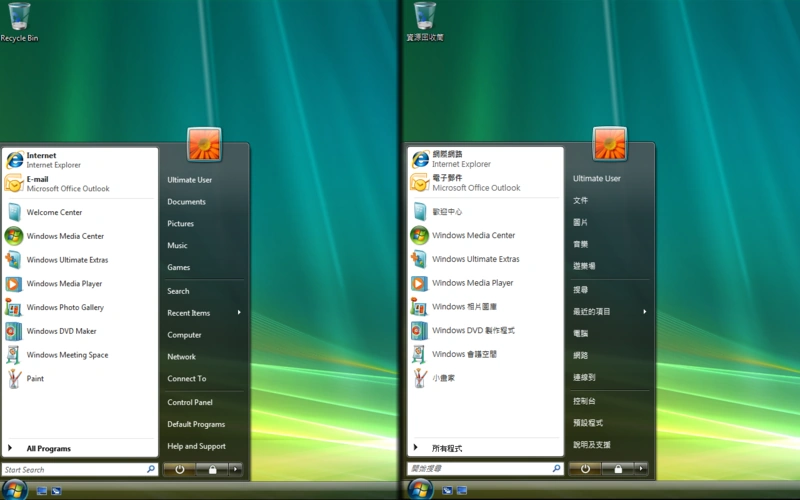

Windows Vista Ultimate Start Menu before Traditional Chinese MUI was applied (left) and after Traditional Chinese MUI was applied (right)
Multilingual User Interface (MUI) is a dynamic localization framework used in Microsoft Windows, Windows Phone, and compatible programs; it allows language files to be modular and separate from application logic. It is designed to simplify the development and deployment of localized software.
MUI has several advantages compared to traditional static localization. Software that uses MUI can do the following:
- Store language resources in dedicated files instead of hardcoding them into program binaries, making it possible to update localizations and code dynamically without recompilation.
- Automatically select a language from Windows' language preferences, instead of asking the user at runtime
- Use the Win32 API to load resources from MUI language files.
The MUI framework, API, and its localization files (called Language Packs, or LPs) were introduced in Windows 2000; these were significantly expanded on with Windows Vista, which allowed developers to use MUI in their software. Language Interface Packs (LIPs) were added in Windows 7 to supplemente Language Packs. LIPs were replaced by Local Experience Packs (LXPs) in Windows 10 version 1809.
The MUI technology is covered by an international patent titled "Multilingual User Interface for an Operating System" (US Patent number: 6252589). Contributors to the invention of MUI include Bjorn C. Rettig, Edward S. Miller, Gregory Wilson, and Shan Xu.
MUI packs for a certain product perform the same task as localized versions of the product, but with some key technical differences. While both localized versions of software and MUI versions display menus and dialogs in the targeted language, only localized versions have translated file and folder names. A localized version of Windows translates the base operating system, as well as all included programs, including file and folder names, objects names, strings in the registry, and any other internal strings used by Windows into a particular language. Localized versions of Windows support upgrading from a previous localized version and user interface resources are completely localized, which is not the case for MUI versions of a product. MUI versions of a product do not contain translated administrative functions such as registry entries and items in Microsoft Management Console.
The advantage of using MUIs over localized versions is that each user on a computer could use a different language MUI without requiring different versions of software installed and dealing with the conflicts that could arise as a result. For example, using MUI technology, any version of Windows can host Windows applications in any other language.
MUI products are available only through volume agreements from Microsoft. They are not available through retail channels. However, some OEMs distribute the product. Check the %windir%\Mui folder for muisetup.exe and run the program to view the available languages (%windir% is the "Windows" folder, typically located on the C:\ drive).
MUI in Windows Vista and later
In Windows 2000 and Windows XP, MUI packs for a product are applied on top of an English version to provide a localized user experience. Windows Vista further advances MUI technology with support for language-neutral binary files supporting multiple language add-ons, with the language-specific resources contained in separate files.
The MUI architecture separates the language resources for the user interface from the binary code of the operating system. This makes it possible to change languages completely without changing the core of Windows. Languages are applied as "language packs" containing the resources needed to localize any part of the user interface in Windows.
MUI language packs are available to users of Windows Vista Enterprise, Windows Vista Ultimate (as part of Windows Ultimate Extras), Windows 7 Enterprise, and Windows 7 Ultimate.
Beginning with Windows Vista, the set of associated MUI APIs are also made available to developers for application development.
See also
- Language Interface Pack (LIP)
External links
 |
Wikipedia
|
|---|