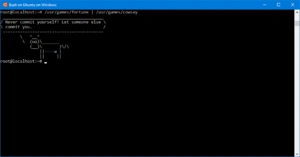

Windows Subsystem for Linux (WSL) is a compatibility layer for running Linux binary executables (in ELF format) natively on Windows 10, Windows 11, and Windows Server 2019 (v1709 and later). Microsoft and Canonical partnered together to enable an Ubuntu image to be downloaded and extracted to the user's local machine, and for the tools and utilities contained within that image to run natively on top of the WSL.
Development
WSL 1
Microsoft announced the completion of the beta testing of the subsystem WSL (Windows Subsystem for Linux), readiness for everyday use and the transfer of WSL to the category of fully supported Windows technologies. WSL was originally available through the Windows Insider program. The ability to run executable Linux files was brought to users in the Windows Fall Creators Update.
The launch of native Linux executables is implemented through a special layer, in which Linux system calls are translated on-the-fly into Windows system calls (a reverse analogue of the Wine system).
Initially, the environment offered to the user was based on the Ubuntu package database and included only console applications, but plans included preparation of environment options based on SUSE and Fedora Linux.
WSL 2
WSL supports Windows 10 v1903 or later for x64, and v2004 or later for ARM64 was later. Build numbers lower than 18362 are no longer supported.[1]
WSLg
The latest release of Windows Subsystem for Linux GUI (WSLg) requires Windows 11 or later. It is not backwards compatible with Linux GUI apps configured for WSL 1, which would need to be updated.[2]
References
- ↑ Manual installation steps for older versions of WSL, Microsoft Docs. 2021-11-12.
- ↑ Run Linux GUI apps on the Windows Subsystem for Linux (preview), Microsoft Docs. 2021-09-27.
See also
External links
- Windows Subsystem for Linux Documentation at Microsoft Docs
- What is Windows Subsystem for Linux (WSL)?
- Install WSL on Windows 10 v2004 and later (2021-09-27)
- Install WSL on Windows Server 2019 v1709 and later (2021-09-27)
- Get started with the Linux command line and the Shell (2021-09-16)
- Ubuntu on WSL at Canonical
- Windows Subsystem for Linux at Wikipedia