 |
Stub
This article is a stub, an article too short to provide more than rudimentary information about a subject. You can help the Microsoft Wiki by expanding it.
|
|---|
Windows XP, the next version of Windows NT after Windows 2000 and the successor to the consumer-oriented Windows Me, has been released in several editions since its original release in 2001.
Windows XP is available in many languages. In addition, add-ons translating the user interface are also available for certain languages.
Main editions
Home and Professional
The first two editions released by Microsoft are Windows XP Home Edition, designed for home users, and Windows XP Professional, designed for business and power users.
Windows XP Professional offers several features that are unavailable in the Home Edition, including:
- The ability to become part of a Windows Server domain, a group of computers that are remotely managed by one or more central servers.
- An access control scheme that allows specific permissions on files to be granted to specific users under normal circumstances. However, users can use tools other than Windows Explorer (such as cacls or File Manager), or restart in Safe Mode to modify access control lists.
- Remote Desktop server, which allows a PC to be operated by another Windows XP user over a local area network or the Internet.
- Offline Files and Folders, which allow the PC to automatically store a copy of files from another networked computer and work with them while disconnected from the network.
- Encrypting File System, which encrypts files stored on the computer's hard drive so they cannot be read by another user, even with physical access to the storage medium.
- Centralized administration features, including Group Policies, Automatic Software Installation and Maintenance, roaming user profiles, and Remote Installation Services (RIS).
- Internet Information Services (IIS), Microsoft's HTTP and FTP server
- Support for two physical CPUs (Because the number of CPU cores and simultaneous multithreading capabilities on modern CPUs are considered to be part of a single physical processor, multi-core CPUs are supported using XP Home Edition.)
- Windows Management Instrumentation Console (WMIC): a command-line tool designed to ease WMI information retrieval about a system by using simple keywords (aliases).
- The ability to switch hard disk storage type from Basic to Dynamic and vice versa.
Edition N
In March 2004, the European Commission fined Microsoft €497 million (US$784 million or £395 million) and ordered the company to provide a version of Windows without Windows Media Player. The Commission concluded that Microsoft "broke European Union competition law by leveraging its near monopoly in the market for PC operating systems onto the markets for work group server operating systems and for media players". After unsuccessful appeals in 2004 and 2005, Microsoft reached an agreement with the Commission where it would release a court-compliant version, Windows XP Edition N. This version does not include the company's Windows Media Player but instead encourages users to pick and download their own media player. Microsoft wanted to call this version Reduced Media Edition, but EU regulators objected and suggested the Edition N name, with the N signifying "not with Media Player" for both Home and Professional editions of Windows XP. Because it sold at the same price as the version with Windows Media Player included, Dell, Hewlett-Packard, Lenovo, and Fujitsu Siemens have chosen not to stock the product. However, Dell did offer the OS for a short time. Consumer interest was low, with roughly 1,500 units shipped to OEMs, and no reported sales to consumers.
The N editions of Windows XP also do not include Windows Movie Maker, but Microsoft made this available as a separate download.
K and KN
In December 2005, the Korean Fair Trade Commission ordered Microsoft to make available editions of Windows XP and Windows Server 2003 that do not contain Windows Media Player or Windows Messenger. Like the European Commission decision, this decision was based on the fact that Microsoft had abused its dominant position in the market to push other products onto consumers. Unlike that decision, however, Microsoft was also forced to withdraw the non-compliant versions of Windows from the South Korean market.
The K and KN editions of Windows XP Home Edition and Professional Edition were released in August 2006, and are only available in English and Korean. Both editions contain links to third-party instant messenger and media player software.
Home Edition ULCPC
This edition of Windows XP Home is intended for sale with certain "low-cost" netbooks and will appear labeled as "Windows XP Home Edition ULCPC" on the back of the netbook (with "ULCPC" standing for "ultra-low-cost personal computer"). This edition contains a regular license of Windows XP Home Edition with Service Pack 3 included.
Professional Blade PC Edition
This version comes preinstalled on OEM solutions providing desktops on Blade PC hardware. In addition to a copy of Windows XP Professional, it includes a Remote Desktop License.
Starter
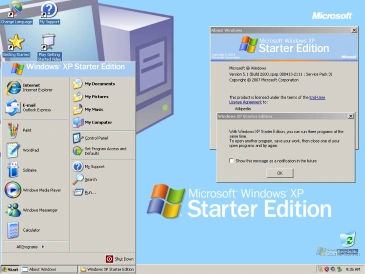

A screenshot of a PC running Windows XP Starter, with Service Pack 3 (SP3).
Windows XP Starter is a lower-cost version of Windows XP available in Thailand, Vietnam, Turkey, Indonesia, the Philippines, Russia, Colombia, Brazil, Argentina, Peru, Bolivia, Chile, Mexico, Ecuador, Uruguay, Malaysia, and Venezuela. It is similar to Windows XP Home, but is limited to low-end hardware, can only run three programs at a time, and has some other features either removed or disabled by default.
According to a Microsoft Press release, Windows XP Starter is "a low-cost introduction to the Microsoft Windows XP operating system designed for first-time desktop PC users in developing countries."
Specialization
The Starter edition includes some special features for certain markets where consumers may not be computer-literate. Not found in the Home Edition, these include localized help features for those who may not speak English, country-specific wallpapers and screensavers, and other default settings designed for easier use than typical Windows XP installations. The Malaysian version, for example, contains a desktop background of the Kuala Lumpur skyline.
In addition, the Starter edition also has some unique limitations to prevent it from displacing more expensive versions of Windows XP. Only three applications can be run at once on the Starter edition, and each application may open a maximum of three windows. The maximum screen resolution is 1024×768, and there is no support for workgroup networking or domains. In addition, the Starter edition is licensed only for low-end processors like Intel's Celeron or AMD's Duron and Sempron. There is also a 512 MB limit on main memory and a 120 GB disk size limit. Microsoft has not made it clear, however, whether this is for total disk space, per partition, or per disk. There are also fewer options for customizing the themes, desktop, and taskbar.
Market adoption
On October 9, 2006, Microsoft announced that it reached a milestone of 1 million units of Windows XP Starter sold. In the mass market, however, the Starter edition did not have much success. In many markets where it is available, pirated versions of higher-end versions of Windows are more popular than their legal counterparts. In these markets, non-genuine copies of XP Professional can be obtained at a mall. These stores typically charge only for the amount of the CDs/DVDs taken up by the files, not the original retail value. Unlicensed copies of Windows XP Professional typically cost $0.70, since it only uses one CD, compared to around $30 for a properly licensed copy of XP Starter.
Media Center Edition
- Main article: Windows XP Media Center Edition
- See also: Windows Media Center
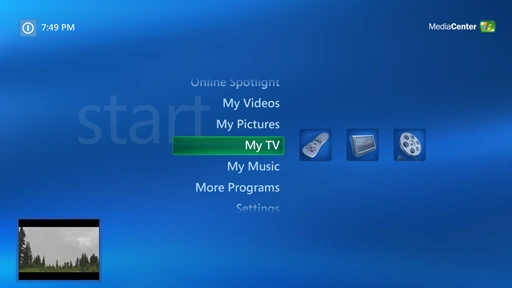

Windows XP MCE 2005 Menu
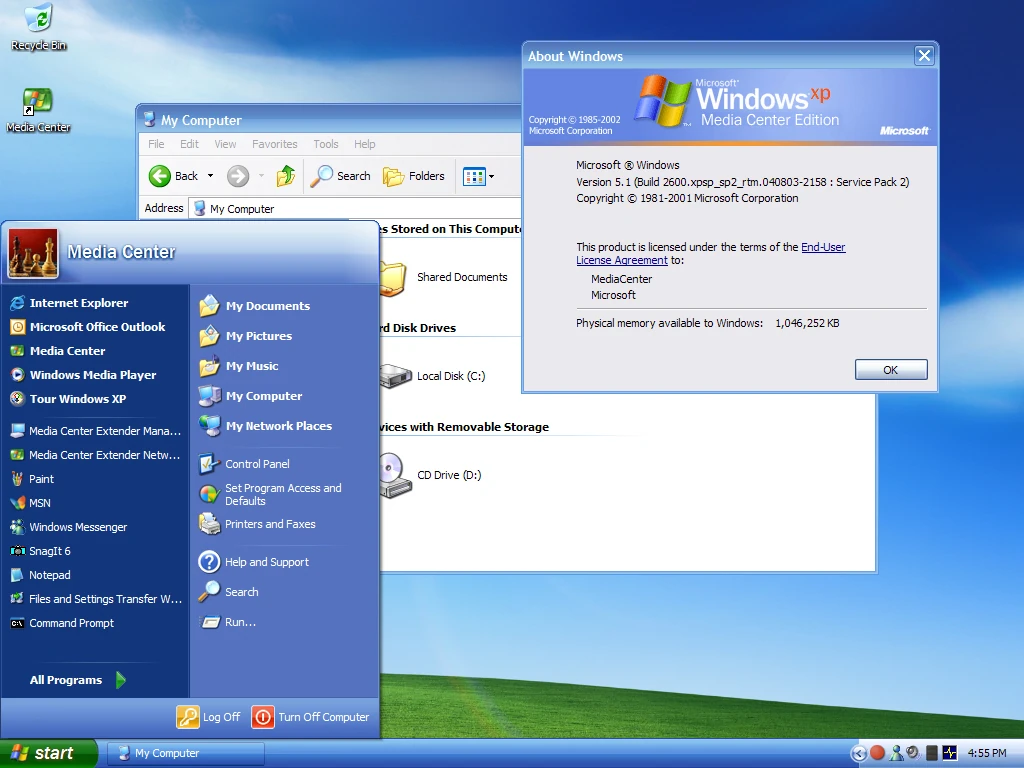

Windows XP MCE 2005's desktop, when Media Center is not running.
This edition, codenamed "Freestyle" during its development, was first released in September 2002. The initial release was available solely in conjunction with computers that included media center capabilities, and could not be purchased separately. The first major update was released in 2004 and distributed by Tier 1 OEMs who had previously sold Windows XP Media Center Edition PC, and then updated again in 2005, which was the first edition available for system builders. Many of the features of Windows XP Media Center Edition 2005 (including screen dancers, auto playlist DJ, and high-end visual screensavers) were taken from the Windows XP Plus! packages. These were originally shipped as add-ons to Windows XP to enhance the users' experience of their Windows XP machine.
Releases
A preview version of Windows XP Media Center Edition from Microsoft's eHome division was shown at CES 2002, with the final version being released in July 2002.
- Windows XP Media Center Edition ("Freestyle", July 2002): the original release. Updates to this release added features such as FM radio tuning. This release combined with updates is sometimes referred to as Windows XP Media Center Edition.
- Windows XP Media Center Edition 2004 ("Harmony", September 2003): Windows XP Service Pack 2 upgrades earlier versions of MCE to this one.
- Windows XP Media Center Edition 2005 ("Symphony", October 2004): the first edition of MCE available to non-Tier 1 system builders. Among other things, it includes support for Media Center Extenders and CD/DVD video burning support.
- Update Rollup 2 for Windows XP Media Center Edition 2005 ("Emerald", October 2005) is a major update to MCE 2005 (Symphony) and was a recommended download. It adds support for the Xbox 360 as a media center extender, DVB-T broadcasts, and support for two ATSC tuner cards.
After the 2005 release, Microsoft focused its efforts on building new media center features into "Home Premium" and "Ultimate" editions of Windows Vista and Windows 7, which have Windows Media Center built in and, unlike the releases of Windows XP Media Center Edition, were available for retail purchase without the necessary hardware.
Features
Hardware requirements
Tablet PC Edition
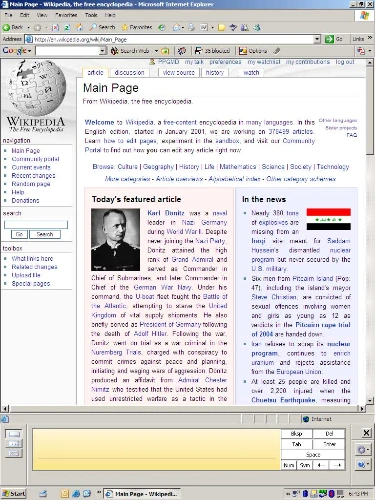

Internet Explorer 6 running on Windows XP Tablet PC Edition.
This edition is intended for specially designed notebook/laptop computers called Tablet PCs. Windows XP Tablet PC Edition is compatible with a pen-sensitive screen, supporting handwritten notes and portrait-oriented screens. Except for MSDN and Volume License subscribers, Windows XP Tablet PC Edition could not be purchased separately.
Tablet PC Edition is a superset of Windows XP Professional, the difference being tablet functionality, including alternate text input (Tablet PC Input Panel) and basic drivers for support of tablet PC specific hardware. Requirements to install Tablet PC Edition include a tablet digitizer or touchscreen device, and hardware control buttons including a Control-Alt-Delete shortcut button, scrolling buttons, and at least one user-configurable application button.
There have been two releases:
- Windows XP Tablet PC Edition: the original version released in November 2002.
- Windows XP Tablet PC Edition 2005: released in August 2004 (codenamed Lonestar) as part of Windows XP Service Pack 2. This edition is available as a service pack upgrade or as a new OEM version.
Windows XP Tablet PC Edition includes all of the software features provided in Windows XP Professional, and also includes some of the following components:
- Tablet PC Input Panel
- Windows Journal
- Sticky Notes
- InkBall
- Energy Blue theme
64-bit editions
Two editions of Windows XP were released to support 64-bit hardware. Despite being similarly named, these were distinct products aimed at separate markets.
"Windows XP 64-bit Edition" was designed to run natively on the Intel Itanium CPU family. "Windows XP Professional x64 Edition", by contrast, ran on standard x86 CPUs which supported the then-new "x86-64" 64-bit extensions.
Windows XP 64-bit Edition
- Main article: Windows XP 64-bit Edition
Windows XP 64-bit Edition (sometimes referred to as simply Windows XP for Itanium [Edition]) was designed to run on the Intel Itanium family of microprocessors in their native IA-64 mode.
Two versions of Windows XP 64-bit Edition were released:
- Version 2002 – based on the Windows XP codebase and released simultaneously alongside the 32-bit (IA-32) version of Windows XP on October 25, 2001.
- Version 2003 – based on the Windows Server 2003 codebase (which added support for the Itanium 2 processor) and released on March 28, 2003.
This edition was discontinued in January 2005, after Hewlett-Packard, the last distributor of Itanium-based workstations, ceased selling Itanium systems as "workstations." As of July 2005, Windows XP 64-bit Edition was still supported, and further security updates were made available to Windows XP Professional x64 Edition. On April 8, 2014, all support for Windows XP 64-bit Edition was discontinued.
Windows XP 64-Bit Edition was not marketed as the Itanium version of Microsoft's other Windows XP editions, but instead as a separate edition designed solely for the Itanium processor and its 64-bit instructions. It is mostly analogous to Windows XP Professional, but numerous older technologies, such as DAO, Jet database, NTVDM, and Windows on Windows, are no longer present, so support for MS-DOS and Win16 applications is absent. These versions also lack most media applications, such as Windows Media Player, NetMeeting, Windows Movie Maker, and integrated CD burning.
Similar to the ability of previous alternate architecture ports of Windows (Windows NT 4.0 for PowerPC, MIPS R4x00, and Alpha) to run 16-bit x86 code via Windows on Windows, Windows XP 64-Bit Edition can run standard x86 32-bit applications through its WOW64 (Windows-on-Windows 64-bit) emulation layer. While the original Itanium processor contains an on-chip IA-32 decoder, it was deemed far too slow for serious use (running at about 400 MHz), so Microsoft and Intel wrote a software 32 to 64-bit translator dubbed the IA-32 Execution Layer. It allows real-time translation of x86 32-bit instructions into IA-64 instructions, allowing 32-bit applications to run (albeit significantly more slowly than native code).
Windows XP Professional x64 Edition
- Main article: Windows XP Professional x64 Edition
Editions for embedded systems
- See also: Windows IoT
Windows XP for Embedded Systems
Windows XP Embedded
- Main article: Windows XP Embedded
Windows Embedded for Point of Service
Windows Fundamentals for Legacy PCs
- Main article: Windows Fundamentals for Legacy PCs
 |
Wikipedia
|
|---|