- For the defunct retail store that used to sell Microsoft products, see Microsoft Store (retail)
Microsoft Store (formerly known as the Windows Store) is a digital distribution platform developed by Microsoft. It was created as an app store for Windows 8 as the primary means of distributing Universal Windows Platform apps. With Windows 10 version 1803, Microsoft merged its other distribution platforms (Windows Marketplace, Windows Phone Store, Xbox Music, Xbox Video, Xbox Games Store, and a web storefront also known as "Microsoft Store") into Microsoft Store, making it a unified distribution point for apps, console games, and digital videos. Digital music was included until the end of 2017, and e-books were included until 2019.
As with other similar platforms, such as Google Play and Mac App Store, the Microsoft Store is curated, and apps must be certified for compatibility and content. In addition to the user-facing Microsoft Store client, the store has a developer portal with which developers can interact. Microsoft takes 5-15% of the sale price for apps and 30% on Xbox games. Before January 1, 2015, this cut was reduced to 20% after the developer's profits reached $25,000. In 2021, 669,000 apps were available in the store. Categories containing the largest number of apps are "Books and Reference", "Education", "Entertainment", and "Games".
History
The Web-based storefront
Microsoft previously maintained a similar digital distribution system for software known as Windows Marketplace, which allowed customers to purchase software online. The marketplace tracked product keys and licenses, allowing users to retrieve their purchases when switching computers. Windows Marketplace was discontinued in November 2008. At this point, Microsoft opened a Web-based storefront called "Microsoft Store".
Windows 8
Microsoft first announced the Windows Store, a digital distribution service for Windows, at its presentation during the Build developer conference on September 13, 2011. Further details announced during the conference revealed that the store would be able to hold listings for both certified traditional Windows apps, as well as what were called "Metro-style apps" at the time: tightly-sandboxed software based on Microsoft design guidelines that are constantly monitored for quality and compliance. For consumers, the Windows Store is intended to be the only way to obtain Metro-style apps. While announced alongside the "Developer Preview" release of Windows 8, the Windows Store itself did not become available until the "Consumer Preview", released in February 2012.
Updates to apps published on the store after July 1, 2019, are no longer available to Windows 8 RTM users. Per Microsoft lifecycle policies, the RTM version of Windows 8 has been unsupported since January 12, 2016, excluding some Embedded editions, as well as its server equivalent, Windows Server 2012.
Windows 8.1
An updated version of the Windows Store was introduced in Windows 8.1. Its home page was remodeled to display apps in focused categories (such as popular, recommended, top free and paid, and special offers) with expanded details, while the ability for apps to automatically update was also added. It also introduced other notable presentation changes, including increasing the top app lists to return 1,000 apps instead of 100 apps, a "picks for you" section, and changing the default sorting for reviews to be by "most popular".
Updates to apps published on the Store after June 30, 2023, are no longer available to Windows 8.1. Per Microsoft lifecycle policies, the Windows 8.1 Update reached the end of its extended support on January 10, 2023, excluding some Embedded editions, as well as its server equivalent, Windows Server 2012 R2.
Windows 10
Windows 10 was released with an updated version of the Windows Store, which merged Microsoft's other distribution platforms (Windows Marketplace, Windows Phone Store, Xbox Video, and Xbox Music) into a unified storefront for Windows 10 on all platforms, offering apps, games, music, films, TV series, themes, and ebooks. In June 2017, Spotify became available in the Windows Store.
In September 2017, Microsoft began to rebrand the Windows Store as Microsoft Store, with a new icon carrying the Microsoft logo. The Xbox Games Store was merged into this new version of the platform. This is in line with Microsoft's platform convergence strategy on all Windows 10-based operating systems.
Web apps and traditional desktop software can be packaged for distribution on the Microsoft Store. Desktop software distributed through the Microsoft Store is packaged using the App-V system to allow sandboxing.
In February 2018, Microsoft announced that Progressive Web Apps would begin to be available in the Microsoft Store, and Microsoft would automatically add selected quality progressive web apps through the Bing crawler or allow developers to submit Progressive Web Apps to the Microsoft Store.
Starting from Windows 10 version 1803, fonts can be downloaded and installed from the Microsoft Store.
Windows 11
In Windows 11, Microsoft Store received an updated user interface and a new pop-up designed to handle installation links from websites. Microsoft also announced several changes to its policies for application submissions to improve flexibility and make the store more "open", including supporting "any kind of app, regardless of app framework and packaging technology", and the ability for developers to freely use first- or third-party payment platforms (in non-game software only) rather than those provided by Microsoft.
Windows Server
The Microsoft Store is not installed by default in Windows Server 2012 or later versions. Apps that would normally be available in the Store can be installed through sideloading.
Store features
Microsoft Store is the primary means of distributing Universal Windows Platform (UWP) apps. Sideloading apps from outside the store is supported on Windows 10 on an opt-in basis, but Windows 8 only allows sideloading to be enabled if the device is running the Enterprise edition of Windows 8 on a domain. Sideloading on Windows RT, Windows 8 Pro, and Windows 8 Enterprise computers without a domain affiliation requires the purchase of additional licenses through volume licensing. Individual developers can register for US$19 and companies for US$99.
Initially, Microsoft took a 30% cut of app sales until it reached US$25,000 in revenue, after which the cut dropped to 20%. On January 1, 2015, the reduction in cut at $25,000 was removed, and Microsoft takes a 30% cut of all app purchases, regardless of overall sales. As of August 1, 2021, Microsoft only takes a 12% cut of app sales. Third-party transactions are also allowed, of which Microsoft does not take a cut.
A range of multimedia content (music, books, movies) was formerly available on the Microsoft Store. They were gradually shut between 2017 and 2025, leaving only the apps & games storefront remaining.
Windows apps and games
In 2015, over 669,000 apps were available on the store, including apps for Windows NT, Windows Phone, and UWP apps, which work on both platforms. Categories containing the largest number of apps are "Games", "Entertainment", "Books and Reference", and "Education". The majority of the app developers have one app. Both free and paid apps can be distributed through the Microsoft Store, with paid apps ranging in cost from US$0.99 to $999.99. Developers from 120 countries can submit apps to the Microsoft Store. Apps may support any of 109 languages, as long as they support one of 12 app certification languages.
From 2016 to 2019, most Microsoft Studios games ported to PC were distributed exclusively via the Microsoft Store. Microsoft later abandoned this strategy in May 2019, amid criticism of limitations faced by UWP-based games, and a desire to also sell games on competing storefronts such as Steam. The new Xbox app subsequently became the main frontend for PC games available via the Microsoft Store, and also integrates the subscription service PC Game Pass.
Former features
Music
- See also: Groove Music
On October 2, 2017, Microsoft announced that the sale of digital music on the Microsoft Store would cease on December 31 after the discontinuation of Groove Music Pass. Users were able to transfer their music to Spotify until January 31, 2018.
Books
Books bought from the Microsoft Store were formerly accessible on the EdgeHTML-based Microsoft Edge. The ability to open ePub e-books was removed during the shift to the Chromium-based Microsoft Edge.
On April 2, 2019, Microsoft announced that the sale of e-books on the Microsoft Store had ceased. Due to DRM licenses that would not be renewed, all books became inaccessible by July 2019, and Microsoft automatically refunded all users who had purchased books via the service.
Movies and TV shows
- See also: Microsoft Movies & TV
Movies and television shows were available for purchase or rental, depending on availability.
Content could be played on the Microsoft Movies & TV app (available for Windows 10, Xbox One, Xbox 360, and Xbox Series X/S), or the Xbox Video app (available for Windows 8/RT PCs and tablets, and Windows Phone 8). In the United States, a Microsoft account can be linked to the Movies Anywhere digital locker service (separate registration required), which allows purchased content to be played on other platforms (e.g., macOS, Android, iOS).
Microsoft Movies & TV was available in the following 21 countries: Australia, Austria, Belgium, Brazil, Canada, Denmark, Finland, France, Germany, Ireland, Italy, Japan, Mexico, Netherlands, New Zealand, Norway, Spain, Sweden, Switzerland, the United States, and the United Kingdom. The purchase of TV shows was not supported in Belgium.
On July 18, 2025, Microsoft announced the closure of its Movies & TV storefront after 12 years of operations. Users who live outside the US can continue to use the Movies & TV app to play previously purchased content until further notice. Microsoft recommended that users who live in the US use Movies Anywhere to sync their Microsoft-purchased content to other supported services, such as Amazon Video or Apple TV.
Business model
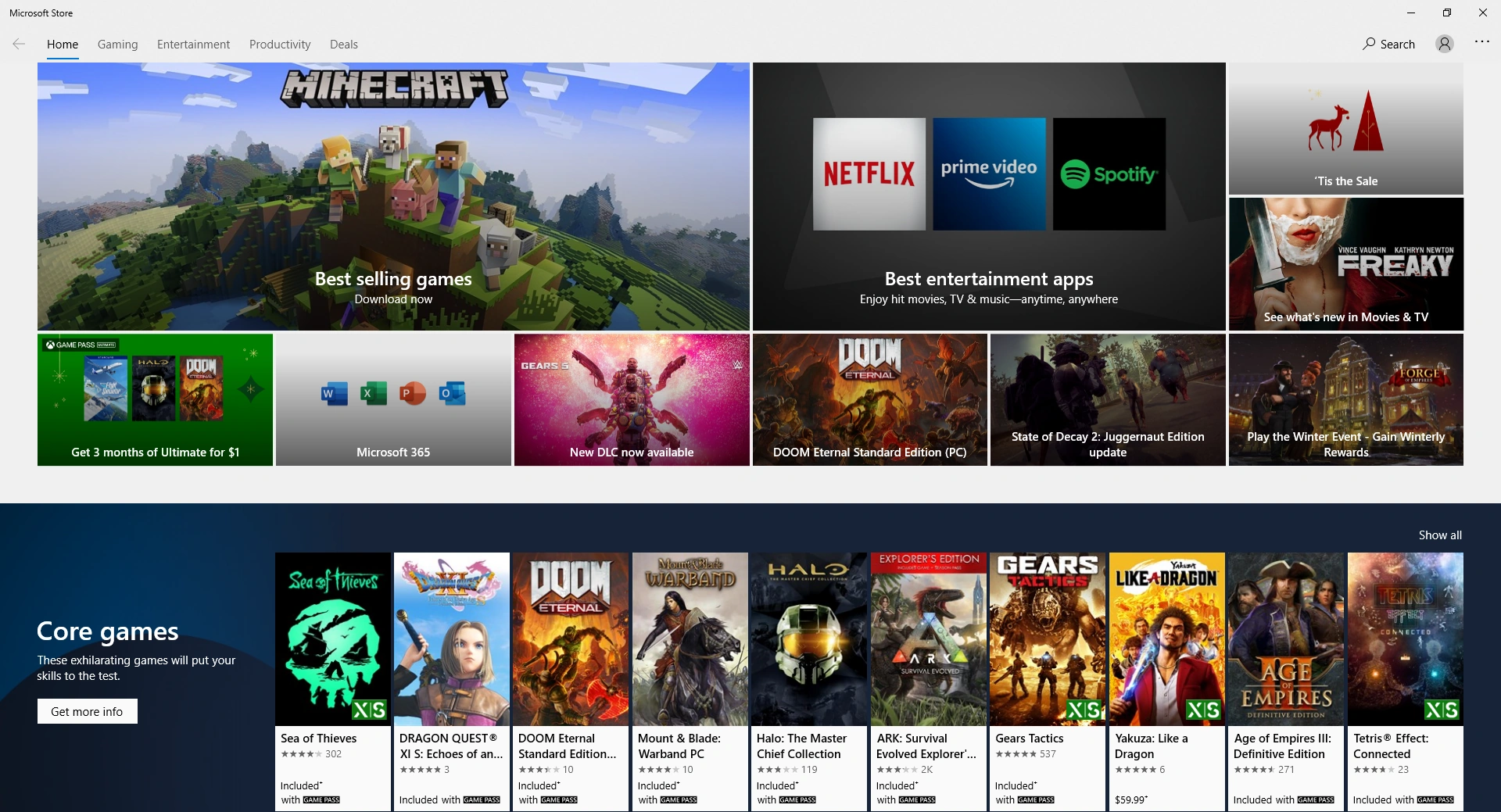

The Microsoft Store under Windows 10.
The Windows Store became the only means of distributing Metro-style apps to users; the official reason is to allow Microsoft to scan apps for security flaws and malware.[1] The Windows Store took a 30% cut of application sales. Once an application reaches $25,000 USD in revenue, the cut drops to 20%. In-app third-party transactions are also allowed, of which Microsoft does not take a cut. Individual developers will be able to register for $49 USD, and $99 USD for companies.[2] On June 24, 2021, Microsoft announced that they would reduce their cut to 15%, which would be dropped to zero if a company brought its own payment system.[3] This special deal does not extend to games, which would be subject to a 12% fee through Microsoft’s payment platform.[4][5]
Guidelines
Similar to the Windows Phone Store, the Microsoft Store is regulated by Microsoft. Applications must be approved by Microsoft before becoming available in the store. Disallowed types of applications revealed by Microsoft (for Developer Preview) include:[6]
- Apps that contain adult content
- Apps with a rating over PEGI 16, ESRB MATURE 17, or that contain content that would warrant such a rating
- Apps that advocate discrimination, hatred, or violence based on membership in a particular racial, ethnic, national, linguistic, religious, or other social groups, or based on a person’s gender, age, or sexual orientation
- Apps that contain content or functionality that encourages, facilitates, or glamorizes illegal activity
- Apps that contain or display content that a reasonable person would consider obscene
- Apps that are Defamatory, libelous, slanderous, or threatening
- Apps that encourage, facilitate, or glamorize excessive or irresponsible use of alcohol or tobacco products, drugs, or weapons
- Apps that encourage, facilitate, or glamorize extreme or gratuitous violence, human rights violations, or the creation or use of weapons against a person or animal in the real world
- Apps that contain excessive or gratuitous profanity
Additionally, video game console emulators that are "primarily gaming experiences or target the Xbox One" and third-party web browsers that use their own layout engines are prohibited on the Microsoft Store.
Microsoft has indicated that it can remotely disable or remove apps from end-user systems for security or legal reasons; in the case of paid apps, refunds may be issued when this is done.
Microsoft initially banned PEGI "18"-rated content from the store in Europe. However, critics noted that this made the content policies stricter than intended, as some PEGI 18-rated games are rated "Mature" on the U.S. ESRB system, which is the next lowest before its highest rating, "Adults Only". The guidelines were amended in December 2012 to remove the discrepancy.
On October 8, 2020, Microsoft announced a commitment to ten "principles" of fairness to developers in the operation of the Microsoft Store. These include transparency over its rules, practices, and Windows' "interoperability interfaces", not preventing competing application storefronts to run on Windows, charging developers "reasonable fees" and not "forc[ing]" them to include in-app purchases, allowing access to the store by any developer as long as their software meets "objective standards and requirements", not blocking apps based on their business model, how it delivers its services, or how it processes payments, not impeding developers from "communicating directly with their users through their apps for legitimate business purposes", not using private data from the store to influence the development of competing for software by Microsoft, and holding its own software to the same standards as others on the store. The announcement came in the wake of lawsuits against Apple, Inc., and Google LLC by Epic Games over alleged anticompetitive practices conducted by their own application stores.
With the release of Windows 11, Microsoft announced that it would not require software (excluding games) distributed via the Microsoft Store to use its own payment platforms, and that it would allow third-party storefronts (such as Epic Games Store) to offer their clients for download via the Microsoft Store.
Reception
Microsoft Store has widely received negative reviews since its inception. Unavailability of popular apps has been the leading reason for the cold reception of the store. Phil Spencer, head of Microsoft Gaming, has also opined that the Microsoft Store "sucks". As a result, Office was removed as an installable app from the store and was made to redirect to its website. Malware has also made its way into the store, masquerading as popular games.
Gallery
References
- ↑ Tom, Warren. "Microsoft details and demos the Windows Store for Windows 8". Winrumors.com. Retrieved 19 September 2011.
- ↑ Leblond, Antoine. "Previewing the Windows Store". Windows Store for developers. Retrieved 6 December 2011.
- ↑ Microsoft reveals the new Microsoft Store for Windows 11, and it has Android apps, too by Sean Hollister, The Verge. 2011-06-24.
- ↑ Microsoft reveals the new Microsoft Store for Windows 11, and it has Android apps, too by Sean Hollister, The Verge. 2011-06-24.
- ↑ Microsoft will let devs keep every penny their Windows app makes — unless it’s a game by Jay Peters, The Verge. 2021-06-24.
- ↑ "Certification requirements for Windows apps". 6 January 2012.
External links
- Microsoft Store (archived 2008-10-07)
- Microsoft Store at Wikipedia