- Not to be confused with Windows NT 3.1.
Windows 3.1 (codenamed Janus) is a major release of Microsoft Windows, a family of graphical operating environments and operating systems. It was released to manufacturing on April 6, 1992, as a successor to Windows 3.0. Like its predecessors, the Windows 3.1 series ran as a shell on top of MS-DOS; it was the last Windows 16-bit operating environment, as all future versions of Windows had moved to 32-bit.
Windows 3.1 introduced the TrueType font system as a competitor to Adobe Type Manager. Its multimedia was also expanded, and screen savers were introduced, alongside new software such as Media Player (also known as "Windows Media Player") and Sound Recorder. File Manager and Control Panel received updates, while Windows 3.1 also introduced the Windows Registry and add-ons. It could utilize more memory than its predecessors.
Subsequent versions were released between 1992 and 1993, until the release of its successor, Windows 95. Official support for Windows 3.1 ended on December 31, 2001. However, OEM licensing for Windows for Workgroups 3.11 on embedded systems remained available until November 1, 2008.
On November 8, 1993, Windows 3.11 was released, which introduced problem corrections. On November 22, 1993, Windows 3.2, a version of Windows 3.11 in Simplified Chinese, was introduced.
Development history
Windows 3.0, the predecessor to 3.1, was released in 1990 and is considered to be the first version of Windows to receive critical acclaim. Windows 3.0 received around 10 million sales before the release of Windows 3.1 on April 6, 1992. Microsoft began a television advertising campaign for the first time on March 1, 1992. The advertisements, developed by Ogilvy & Mather, were designed to introduce a broader audience to Windows.
Like its predecessors, the operating environment runs as a shell on top of MS-DOS, although it does not include the MS-DOS Executive shell. After the introduction of Windows 1.0, Microsoft had worked on gaining support from companies to expand its operating environment to different types of PCs. Tandy Corporation was open to shipping Tandy Sensation PCs with Windows 3.1. IBM and its PCs were also provided with Windows 3.1.
Windows for Workgroups
Windows for Workgroups is an extension to Windows 3.1x, allowing communication with a workgroup using the SMB protocol over NetBIOS. The first version, Windows for Workgroups 3.1, was released in October 1992.
Windows for Workgroups 3.1
Windows for Workgroups 3.1 (codenamed Winball and Sparta during development) was released in October 1992, and is an extended version of Windows 3.1 that includes native networking support. It comes with SMB file sharing support via NetBIOS-based NBF and/or IPX network transport protocols, as well the introduction of the Hearts card game and VSHARE.386, a VxD version of SHARE.EXE.
Windows for Workgroups 3.11
Windows for Workgroups 3.11 (codenamed Snowball) was released on August 11, 1993. It supported 32-bit file access, full 32-bit network redirectors, and VCACHE.386 file cache, shared between them. WFW 3.11 requires a 386 machine to run, as standard mode support has been dropped.
A Winsock package was required to support TCP/IP networking in Windows 3.x. Usually third-party packages were used, but in August 1994, Microsoft released an add-on package (codenamed Wolverine) that provided TCP/IP support in Windows for Workgroups 3.11. Wolverine was a 32-bit stack, which gave it superior performance to most of the third-party TCP/IP Windows stacks available. However, it was only compatible with WFW 3.11, and lacked dial-up support. Wolverine would later ship with Windows 95.
Editions
Microsoft Windows Version 3.1x Compatible Logo (1994-2001).
Windows 3.1



New Features
- TrueType font support.
- 32-bit disk access
- Minesweeper
- Enhanced mode DOS/Windows interaction (some DOS programs can use Windows Clipboard)
- Icons are more detailed and can be dragged/dropped.
- RAM limit increased to 64 MB (single applications limited to 16 MB)
- Standard Multimedia support.
- 32-bit disk access (Improved Windows performance)
Windows 3.1 Multimedia PC Version (Beta)
- Codename: Bombay
- Release Date: November 1992
New Features
- Media Viewer
- Video File Player.
- Integrated sound and video with CD-ROM support.
Removed features
- CGA graphics support (can be manually re-added from Windows 3.0xx)
- Windows 2.xx application compatibility.
- Reversi game
Windows 3.1xE (for Central and Eastern Europe)
- Support for Cyrillic, Polish and other Central/Eastern European languages.
Windows 3.1J (Japan)
- Release Date: 1993
- Support for the Japanese language
Modular Windows
- Designed for the Tandy Video Information System.
Windows 3.11
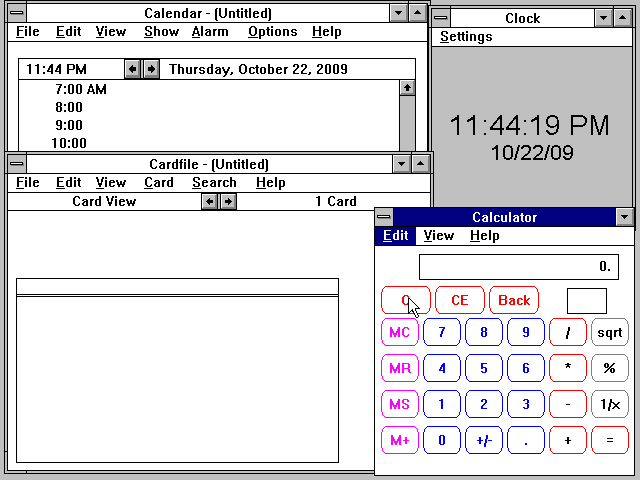
Windows 3.11
- Same Codename as Windows 3.1: Janus
- Release Date: August 1993
- Patch/bugfix release.
Windows 3.2
- Release Date: November 22, 1993
- Simplified Chinese character support.
Windows for Workgroups 3.1
- Codename: Kato (Winball)/Jastro (Sparta)
- Release Date: October 1992
New Features
- Added native networking support via Windows real mode drivers. Comes with SMB file sharing via NetBIOS-based NBF and/or IPX network transport protocols>.
- Hearts
- VSHARE.386, the Virtual Device Driver Windows based version of the SHARE.EXE Terminate and Stay Resident program.
Windows for Workgroups 3.11
- Codename: Snowball
- Release Date: August 11, 1993 (shipped November 1993)
- Requires 386 or better
New Features
- Full 32-bit network redirectors, and the VCACHE.386 file cache, shared between them.
Windows NT 3.1
- Codename: AXP/93
- Release Date: July 27, 1993
New Features
- NT version of Windows 3.1x.
Add-ons
Winsock
A Winsock package was required to support TCP/IP networking in Windows 3.x. Usually third-party packages were used, but in August 1994, Microsoft released an add-on package (codenamed Wolverine) that provided TCP/IP support in Windows for Workgroups 3.11. Wolverine was a 32-bit stack (accessible from 16-bit Windows applications via WinSock thunks), which gave it superior performance to most of the third-party TCP/IP Windows stacks available. However, it was only compatible with Windows for Workgroups 3.11, and lacked support for dial-up. The Wolverine stack was an early version of the TCP/IP stack that would later ship with Windows 95, and provided an early testbed for the 16-to-32-bit compatibility layer that was crucial to Windows 95's success.
Video for Windows
Release Date: November 1992 (Windows 3.1 and Windows 3.11)
Features
- Audio Video Interleave (AVI) format for video.
- Added a application programming interface that allowed software developers working on the Windows platform to add the ability to play or manipulate digital video to their own applications.
- Included software for playing and manipulating digital video.
Windows for Pen Computing
Windows for Pen Computing 1.0 was a series of Microsoft-produced add-ons for Microsoft Windows versions in 1992 with additional tools for tablet PCs. Became obsolete due to Tablet PC support for Windows XP Tablet PC Edition in 2002.
Win32s
Windows 3.1'x was given limited compatibility with the then-new 32-bit Windows API used by Windows NT by another add-on package, Win32s. There was a rumor that Microsoft did not want to increment any mainstream Windows 3.1'x version to something like Windows 3.2 because it could be confused with the Win32 API or otherwise distract consumers from upgrading to a real 32-bit OS like the then-upcoming Windows 95 was, though Windows NT 3.1 and 3.5 were both 32-bit operating systems that looked similar in appearance. For testing of the new Win32s functions the game FreeCell was included.
Controversy
DR-DOS compatibility
The installer to the beta release used code that checked whether it was running on Microsoft-licensed DOS or another DOS operating system (such as DR-DOS). The code ran several functional tests that succeeded on MS-DOS and IBM PC DOS, but resulted in a technical support message on competing operating systems. If the system was not MS-DOS, the installer would fail. Digital Research, who owned DR-DOS, released a patch within weeks to allow the installer to continue. Microsoft disabled, but did not remove, this warning message for the final release of Windows 3.1. When Caldera bought DR-DOS from Novell, they brought a lawsuit against Microsoft over the AARD code, which was later settled.
Trivia
- This is the first Windows version to be released after the Cold War.
Gallery of Screenshots
Windows 3.1


Windows 3.11 for Workgroups


Windows 3.2 (Simplified Chinese version)


External links
- Windows Version History (1.x-3.11) at Microsoft (archived 2005-05-25)
- Windows for Workgroups version history (archived 2006-11-07)
- Microsoft Windows Simplified Chinese 3.2 Upgrade Is Available (archived 2004-05-13)
- Microsoft History: 1992, 1993, 1994 at Microsoft Library (archived 1996-10-17)
- DOS/V, Windows, Prices, and the Future... at Computing Japan (1994-08)
- Windows 3.1 at GUIdebook
- Microsoft Windows 3.10 at PCjs Machines
- The end of an era - Windows 3.x by Mark Ward at BBC (2008-11-05)
- Windows 3.1x at Wikipedia
 |
Wikipedia (article: Windows 3.1x)
|
|---|
Microsoft Windows family
|
|---|
| Versions • Components • History |
| Original |
| DOS-based |
| Windows 1.0 • Windows 2.0 • Windows 2.1 (Windows/286 • Windows/386) • Windows 3.0 • Windows 3.1 |
| Windows 9x |
| Windows 95 • Windows 98 • Windows Me |
| Windows NT |
| Early versions |
| Windows NT 3.1 • Windows NT 3.5 • Windows NT 3.51 • Windows NT 4.0 • Windows 2000 |
| Client |
| Windows XP (development) • Windows Vista (editions • development) • Windows 7 (editions • development) • Windows 8 • Windows 10 • Windows 11 |
| Windows Server |
| Server 2003 • Server 2008 (2008 R2) • HPC Server 2008 • Home Server • Small Business Server • Essential Business Server • Windows Server 2012 • Windows Server 2016 • Windows Server 2019 • Windows Server 2022 |
| Specialized |
| Windows Embedded • Windows PE • Windows Fundamentals for Legacy PCs |
| Mobile |
| Windows Mobile • Windows Phone |
| Cancelled |
| Cairo • Nashville • Neptune • Odyssey • Windows 10X |
| Related |
| Metro • Midori • OS/2 • Windows Aero • Windows Setup • Windows XP themes • Microsoft Plus! |