Windows 98 (codenamed Memphis) is a graphical operating system by Microsoft. It is the second major release in the Windows 9x line of operating systems. It was released to manufacturing on May 15, 1998 and to retail on June 25, 1998. Windows 98 is the successor to Windows 95. Like its predecessors, it is a hybrid 16-bit/32-bit monolithic product with an MS-DOS-based boot stage.
Windows 98 is web-integrated and bears numerous similarities to its predecessor. Most of its improvements were cosmetic or designed to improve the user experience, but there were also a handful of features introduced to enhance system functionality and capabilities, including improved USB support and accessibility, and support for hardware advancements such as DVD players. Windows 98 was the first edition of Windows to adopt the Windows Driver Model, and introduced features that would become standard in future generations of Windows, such as Disk Cleanup, Windows Update, multi-monitor support, and Internet Connection Sharing.
Microsoft had marketed Windows 98 as a "tune-up" to Windows 95, rather than an entirely improved next generation of Windows. Upon release, Windows 98 was generally well-received for its web-integrated interface and ease of use, as well as its addressing of issues present in Windows 95, although some pointed out that it was not significantly more stable than Windows 95. It saw one major update, known as Windows 98 Second Edition (SE), released on June 10, 1999. After the release of its successor, Windows Me in 2000, mainstream support for Windows 98 and 98 SE ended on June 30, 2002, followed by extended support on July 11, 2006 along with Windows Me's end of extended support.
Development
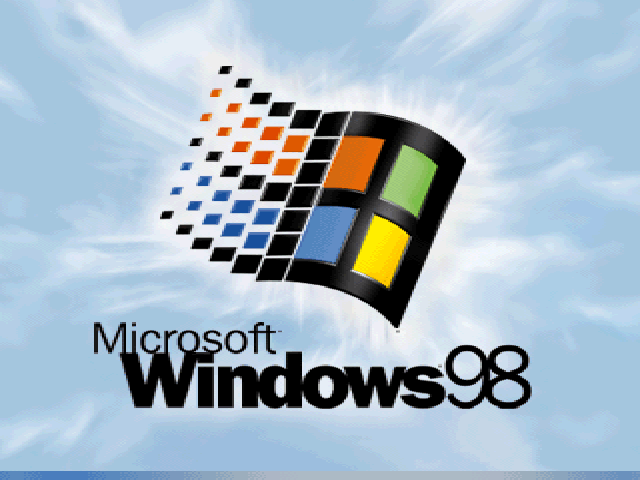

The Windows 98 startup screen.
Development of Windows 98 began following the success of Windows 95, initially under the codename "Memphis." The first test version, Windows Memphis Developer Release, was released in January 1997.
| Build Number | Date | Description | Released as |
|---|---|---|---|
| 1387 | February 7, 1997 | Windows Memphis Alpha (Windows 98 Alpha) | |
| 1602 | October 3, 1997 | The first build to be able to upgrade from Windows 3.1x. | Windows 98 Official Beta 2.1 (Windows 97) |
| 1624 | November 7, 1997 | The first 98 build with new startup and shutdown sounds. | Windows 98 Official Beta 2.1/3 (Windows 97) |
| 1691 | February 16, 1998 | Expired on December 31 1998 | Windows 98 Zeroth Release Candidate (Windows Memphis Release Candidate 0/Windows 98 Release Candidate 0) |
| 1998.5 | May 9, 1998 | Expired December 31 1998 | Windows 98 Final Beta? (Windows Memphis Last BETA?/Windows 98 Office Release Candidate 5) |
| 2106-2185A | May 11, 1998 | Alpha/Beta Versions of Windows 98 Plus!-Second Editions | Windows 99 |
| 2222/2222A | April 23, 1999 | Second version/edition of Microsoft Windows | Windows 98 Second Edition |
New and updated features
Web integration and shell enhancements
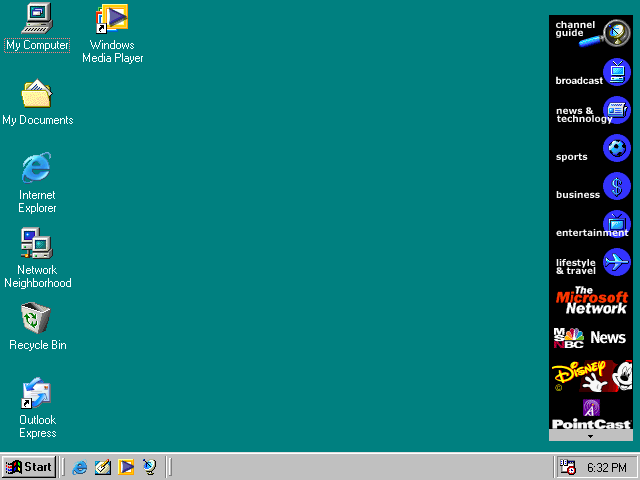

Windows 98 includes Internet Explorer 4.01. Besides Internet Explorer, many other Internet companion applications are included such as Outlook Express, Windows Address Book, FrontPage Express, Microsoft Chat, Personal Web Server and a Web Publishing Wizard, NetMeeting and NetShow Player (in the original release of Windows 98) which was replaced by Windows Media Player 6.2 in Windows 98 Second Edition.
The Windows 98 shell includes all of the enhancements from Windows Desktop Update, an Internet Explorer 4 component, such as the Quick Launch toolbar, deskbands, Active Desktop, Channels, ability to minimize foreground windows by clicking their button on the taskbar, single click launching, Back and Forward navigation buttons, favorites, and address bar in Windows Explorer, image thumbnails, folder infotips and web view in folders, and folder customization through HTML-based templates.

Windows 98 Plus! Edition
Windows 98 also integrates shell enhancements, themes and other features from Microsoft Plus! for Windows 95 such as DriveSpace 3, Compression Agent, Dial-Up Networking Server, Dial-Up Scripting Tool and Task Scheduler. 3D Pinball is included on the CD-ROM but not installed by default. Windows 98 had its own separately purchasable Plus! pack called Plus! 98.
Title bars of windows and dialog boxes support two-color gradients. Windows 98 menus and tooltips support slide animation. Windows Explorer in Windows 98, like Windows 95, converts all uppercase filenames to Sentence case for readability purposes, however, it also provides an option Allow all uppercase names to display them in their original case. Windows Explorer includes support for compressed CAB files. The Quick Res and Telephony Location Manager Windows 95 PowerToys are integrated.
Improvements to hardware support
Windows Driver Model
- Main article: Windows Driver Model
Windows 98 was the first operating system to use the Windows Driver Model (WDM). This fact was not well publicized when Windows 98 was released, and most hardware producers continued to develop drivers for the older VxD driver standard, which Windows 98 also supported. The WDM standard only achieved widespread adoption years later, mostly through Windows 2000 and Windows XP, as they are not compatible with the older VxD standard. Windows Driver Model was introduced largely so that developers would write source compatible drivers for all future versions of Windows. Device driver access in WDM is actually implemented through a VxD device driver, NTKERN.VXD which implements several Windows NT-specific kernel support functions. NTKERN creates IRPs and sends them to WDM drivers.
Support for WDM audio enables digital mixing, routing and processing of simultaneous audio streams and kernel streaming with high quality sample rate conversion on Windows 98. WDM Audio allows for software emulation of legacy hardware to support MS-DOS games, DirectSound support and MIDI wavetable sythesis. The Windows 95 11-device limitation for MIDI devices is eliminated. A Microsoft GS Wavetable Synthesizer licensed from Roland shipped with Windows 98 for WDM audio drivers. Windows 98 supports digital playback of audio CDs, and the Second Edition improves WDM audio support by adding DirectSound hardware mixing and DirectSound 3D hardware abstraction, DirectMusic kernel support, KMixer sample-rate conversion (SRC) for capture streams and multichannel audio support. All audio is sampled by the Kernel Mixer to a fixed sampling rate which may result in some audio getting upsampled or downsampled and having a high latency, except when using Kernel Streaming or third party audio paths like ASIO which allow unmixed audio streams and lower latency. Windows 98 also includes a WDM streaming class driver (Stream.sys) to address real time multimedia data stream processing requirements and a WDM kernel-mode video transport for enhanced video playback and capture.
Windows Driver Model also includes Broadcast Driver Architecture, the backbone for TV technologies support in Windows. WebTV for Windows utilized BDA to allow viewing television on the computer if a compatible TV tuner card is installed. TV listings could be updated from the Internet and WaveTop Data Broadcasting allowed extra data about broadcasts to be received via regular television signals using an antenna or cable, by embedding data streams into the vertical blanking interval (VBI) portion of existing broadcast television signals.
USB
Windows 98 had more robust USB support (e.g. support for USB composite devices) than Windows 95 which only had support in OEM versions (OSR2.1 or later). Windows 98 supports USB hubs, USB scanners and imaging class devices. Windows 98 also introduces built-in support for some USB Human Interface Device class (USB HID) and PID class devices such as USB mice, keyboards, force feedback joysticks etc. including additional keyboard functions through a certain number of Consumer Page HID controls.
USB audio device class support is present from Windows 98 SE onwards. Windows 98 Second Edition improved WDM support in general for all devices, and it introduced support for WDM for modems (and therefore USB modems and virtual COM ports). Microsoft driver support for both USB printers, and for USB mass-storage device class is not available for Windows 98; support for both was introduced in Windows 2000; however generic third party free drivers are available today for USB MSC devices.
ACPI
Windows 98 introduced ACPI 1.0 support which enabled Standby (ACPI S3) and Hibernate (ACPI S4) states. However, hibernation support was extremely limited, and vendor-specific. Hibernation was only available if compatible (PnP) hardware and BIOS are present, and the hardware manufacturer or OEM supplied compatible WDM drivers, non-VxD drivers. However, there are hibernation issues with the FAT32 file system, making hibernation problematic and unreliable.
Other device support improvements
Windows 98, in general, provides improved—and a broader range of—support for IDE and SCSI drives and drive controllers, floppy drive controllers and all other classes of hardware than Windows 95. There is integrated Accelerated Graphics Port (AGP) support (The USB Supplement to Windows 95 OSR2 and later releases of Windows 95 did have AGP support). Windows 98 has built-in DVD support and UDF 1.02 read support. The Still imaging architecture (STI) with TWAIN support was introduced for scanners and cameras and Image Color Management 2.0 for devices to perform color space transformations. Multiple monitor support allows using up to 8 multiple monitors and/or multiple graphics adapters on a single PC. Windows 98 shipped with DirectX 5.2 which notably included DirectShow. Windows 98 Second Edition shipped with DirectX 6.1.
Networking enhancements
- Main article: Winsock
Windows 98 networking enhancements to TCP/IP include built-in support for Winsock 2, SMB signing, a new IP Helper API, Automatic Private IP Addressing (APIPA) (also known as link-local addressing), IP multicasting (including IGMPv2 support and ICMP Router Discovery – RFC 1256), and performance enhancements for high-speed high bandwidth networks (TCP large windows and time stamps – RFC 1323, Selective Acknowledgement (SACK) – RFC 2018, TCP Fast Retransmit and Fast Recovery). Multihoming support with TCP/IP is improved and includes RIP listener support.
The DHCP client has been enhanced to include address assignment conflict detection and longer timeout intervals. NetBT configuration in the WINS client has been improved to continue persistently querying multiple WINS servers if it failed to establish the initial session until all of the WINS servers specified have been queried or a connection is established.
NDIS 5.0 support means Windows 98 can support a wide range of network media, including Ethernet, Fiber Distributed Data Interface (FDDI), token ring, Asynchronous Transfer Mode (ATM), wide area networks (WANs), ISDN, X.25, and Frame Relay. Additional features include NDIS power management, support for QoS, WMI and support for a single INF file format across all Windows versions.
Windows 98 Dial-Up Networking supports PPTP tunneling, support for ISDN adapters, multilink support, and connection-time scripting to automate non-standard login connections. Multilink channel aggregation enables users to combine all available dial-up lines to achieve higher transfer speeds. PPP connection logs can show actual packets being passed and Windows 98 allows PPP logging per connection. The Dial-Up Networking improvements are also available in Windows 95 OSR2 and downloadable for earlier Windows 95 releases.
For networked computers that have user profiles enabled, Windows 98 introduces Microsoft Family Logon which lists all users that have been configured for that computer, enabling users to simply select their names from a list rather than having to type it in. The same feature can be added to Windows 95 if Internet Explorer 4.0 is installed.
Windows 98 supports IrDA 3.0 that specifies both Serial Infrared Devices (SIR) and Fast Infrared (FIR) devices, which are capable of sending and receiving data at 4 Mbit/s. Infrared Recipient, a new application for transferring files through an infrared connection is included. The IrDA stack in Windows 98 supports networking profiles over the IrCOMM kernel-mode driver. Windows 98 also has built-in support for browsing DFS trees on SMB shares.
Windows 98 Second Edition added Internet Connection Sharing (IP forwarding and NAT capabilities). Windows Me later supported NAT traversal by means of UPnP. UPnP and NAT traversal APIs can also be installed on Windows 98 by installing the Windows XP Network Setup Wizard. An L2TP/IPsec VPN client can also be downloaded. By installing Active Directory Client Extensions, Windows 98 can take advantage of several Windows 2000 Active Directory features .
Improvements to the system and built-in utilities
Performance improvements
Windows 95 introduced the 32-bit, protected-mode cache driver, VCACHE replacing SMARTDrv to cache the most recently accessed information from the hard drive in memory, divided into chunks. However, the cache parameters needed manual tuning as it degraded performance by consuming too much memory and not releasing it quickly enough, forcing paging to occur far too early. The Windows 98 VCACHE cache size management for disk and network access, CD-ROM access and paging is more dynamic compared to Windows 95 resulting in no tuning required for cache parameters. On the FAT32 file system, Windows 98 has a MapCache performance feature that can run applications from the disk cache itself if the code pages of executable files are aligned/mapped on 4K boundaries, instead of copying them to virtual memory. This results in more memory being available to run applications, and lesser usage of the swap file.
Windows 98 registry handling is more robust than Windows 95 to avoid corruption and there are several enhancements to eliminate limitations and improve registry performance. The Windows 95 registry key size limitation of 64 KB is gone. The registry uses lesser memory and has better caching.
WinAlign (Walign.exe and Winalign.exe) are tools designed to optimize the performance of executable code (binaries). WinAlign aligns binary sections along 4 KB boundaries, aligning the executable sections with the memory pages. This allows the Windows 98 MapCache feature to map directly to sections in cache Walign.exe is included in Windows 98 for automatically optimizing Microsoft Office programs. Winalign.exe is included in the Windows 98 Resource Kit to optimize other programs.
Disk Defragmenter has been improved to rearrange program files that are frequently used to a hard disk region optimized for program start.
Windows 98 also supports a Fast Shutdown feature that initiates shutdown without uninitializing device drivers. Windows 98 supports write-behind caching for removable disk drives. A FAT32 converter utility for converting FAT16 drives to FAT32 without formatting the partition is also included.
Other system tools
Several improvements have been made to various other system tools and accessories in Windows 98. Microsoft Backup supports differential backup and SCSI tape devices in Windows 98. Disk Cleanup, a new tool, enables users to clear their disks of unnecessary files. Cleanup locations are extensible through Disk Cleanup handlers. Disk Cleanup can be automated for regular silent cleanups.
Scanreg (DOS) and ScanRegW are Registry Checker tools used to back up, restore or optimize the Windows registry. ScanRegW tests the registry's integrity and saves a backup copy each time Windows successfully boots. The maximum amount of copies could be customized by the user through "scanreg.ini" file. The restoration of a registry that causes Windows to fail to boot can only be done from DOS mode using ScanReg.
System Configuration Utility (also known as Msconfig) is a new system utility used to disable programs and services that are not required to run the computer. A Maintenance Wizard is included that schedules and automates ScanDisk, Disk Defragmenter and Disk Cleanup. Windows Script Host, with VBScript and JScript engines is built-in and upgradeable to version 5.6.
System File Checker checks installed versions of system files to ensure they were the same version as the one installed with Windows 98 or newer. Corrupt or older versions are replaced by the correct versions. This tool was introduced to resolve the DLL hell issue and was replaced in Windows Me by System File Protection.
The Windows 98 Startup Disk contains generic, real-mode ATAPI and SCSI CD-ROM drivers and has been preconfigured to automatically start MS-DOS mode with CD-ROM support enabled. For computers without an operating system and that do not support booting from optical drives, the Startup disk can be used to boot into MS-DOS and automatically start Windows 98 setup from the CD.
Windows 98 includes an improved version of the Dr. Watson utility that collects and lists comprehensive information such as running tasks, startup programs with their command line switches, system patches, kernel driver, user drivers, DOS drivers and 16-bit modules. With Dr. Watson loaded in the system tray, whenever a software fault occurs (general protection fault, hang, etc.), Dr. Watson will intercept it and indicate what software crashed and its cause. All of the collected information is logged to the \Windows\DrWatson folder.
Windows Report Tool takes a snapshot of system configuration and lets users submit a manual problem report along with system information to technicians. It has e-mail confirmation for submitted reports. The system could be updated using Windows Update. A utility to automatically notify of critical updates was later released.
Accessories
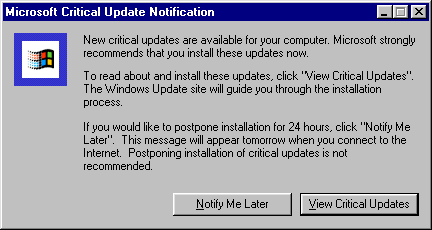

A Critical Update Notification in Windows 98
Windows 98 includes Microsoft Magnifier, Accessibility Wizard and Microsoft Active Accessibility 1.1 API upgradeable to MSAA 2.0. A new HTML Help system with 15 Troubleshooting Wizards was introduced to replace WinHelp.
Users can configure the font in Notepad. Microsoft Paint supports GIF transparency. HyperTerminal supports a TCP/IP connection method allowing it to be used as a Telnet client. Imaging for Windows is updated. System Monitor supports output to a log file.
Miscellaneous improvements
- Telephony API (TAPI) 2.1
- DCOM version 1.2
- Ability to list fonts by similarity determined using PANOSE information.
- Tools to automate setup such as Batch 98 and INFInst.exe, support error-checking, gathering information automatically to create an INF file directly from the registry of the machine, customizing IE4, shell and desktop settings and adding custom drivers.
- Several other Resource Kit tools are included on the Windows 98 CD.
- Windows 98 has new system event sounds for low battery alarm and critical battery alarm. The Windows 98 startup sound was composed by Ken Kato.
- Windows 98 shipped with Flash Player and Shockwave Player preinstalled.
Second Edition
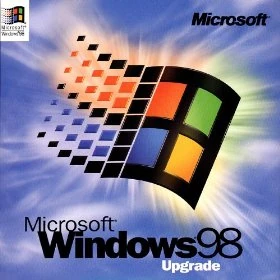

Microsoft Windows 98 Upgrade (First Edition)
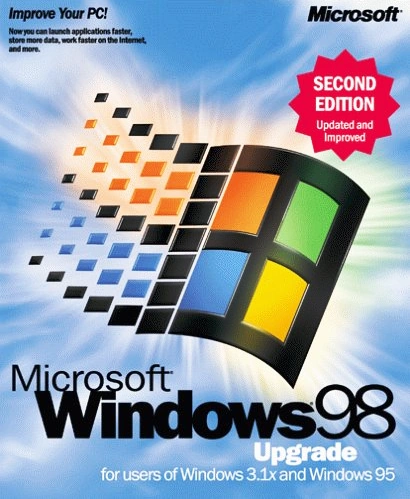

Microsoft Windows 98 Upgrade Second Edition (for users of Windows 3.1x/95)
Windows 98 Second Edition (often shortened to SE) is an updated version of Windows 98 released on June 10, 1999, about eight months before the release of the business-oriented Windows 2000. It includes many bug fixes, improved WDM audio and modem support, improved USB support, added SSE2 support, the replacement of Internet Explorer 4 with Internet Explorer 5, Web Folders (WebDAV namespace extension for Windows Explorer), and related shell updates. Also included is basic OHCI-compliant FireWire (IEEE 1394a) DV camcorder support (MSDV class driver) and SBP-2 support for mass storage class devices. Wake-On-LAN reenables suspended networked computers due to network activity, and Internet Connection Sharing allows multiple networked client computers to share an Internet connection via a single host computer.
Other features in the update include DirectX 6.1, which introduced major improvements to DirectSound and the introduction of DirectMusic, improvements to Asynchronous Transfer Mode support (IP/ATM, PPP/ATM, and WinSock 2/ATM support), Windows Media Player 6.1 replacing the older Media Player 4.1, Microsoft NetMeeting 3.0, MDAC 2.1, and WMI. A memory overflow issue was resolved in which earlier versions of Windows 98 would crash most systems if left running for 49.7 days (equal to 232 milliseconds); this bug was also present on its predecessor, Windows 95. Windows 98 SE could be obtained as retail upgrade and full version packages, as well as OEM and a Second Edition Updates Disc for existing Windows 98 users. USB audio device class support is present from Windows 98 SE onwards. Windows 98 Second Edition improved WDM support in general for all devices, and it introduced support for WDM for modems (and therefore USB modems and virtual COM ports). However, Microsoft driver support for both USB printers and USB mass-storage device class is not available for Windows 98.
| Release | Version | Release Date | Internet Explorer Version |
|---|---|---|---|
| Windows 98/Windows 98 Plus! Edition | 4.10.1998 | June 25, 1998 | 4.01 |
| Windows 98 Second Edition | 4.10.2222 | April 23, 1999 | 5.0 |
Removed features
The Active Channels Channel bar from the original release of Windows 98 is not installed upon first boot; however, it is retained when upgrading from the original release of Windows 98 to Windows 98 Second Edition.
Windows 98 SE did not ship with the WinG API or RealPlayer 4.0, unlike the original release of Windows 98, due to both of these having been superseded by DirectX and Windows Media Player, respectively. On the other hand, ActiveMovie still exists in Windows 98 SE despite having been superseded by Windows Media Player.
Upgradeability
Several components of the Windows 98 original release and Windows 98 Second Edition, can be updated to newer versions. They include:
- Internet Explorer 6 SP1 and Outlook Express 6 SP1
- Windows Media Format Runtime and Windows Media Player 9 Series on Windows 98 SE and Windows Media Player 7.1 on Windows 98.
- Windows Media Encoder 7.1 and Windows Media 8 Encoding Utility
- DirectX 9.0c
- MSN Messenger 7.0
- Significant features from newer Microsoft operating systems can be installed on Windows 98. Chief among them are .NET Framework versions 1.0, 1.1 and 2.0, Visual C++ 2005 runtime, Windows Installer 2.0, GDI+ redistributable library, Remote Desktop Connection client 5.1 and the Text Services Framework.
- Several other components such as MSXML 3.0 SP7, Microsoft Agent 2.0, NetMeeting 3.01, MSAA 2.0, ActiveSync 3.8, WSH 5.6, Microsoft Data Access Components 2.81 SP1, WMI 1.5 and Speech API 4.0.
- Office XP is the last version of Microsoft Office to be compatible with Windows 98.
- Although Windows 98 does not fully support Unicode, certain Unicode applications can run by installing the Microsoft Layer for Unicode.
- KernelEx (independent from Microsoft) allows several newer applications like Firefox 8.0 to run:)
Press demonstration
The release of Windows 98 was preceded by a notable press demonstration at Comdex in April 1998. Microsoft CEO Bill Gates was highlighting the operating system's ease of use and enhanced support for Plug and Play (PnP). However, when presentation assistant Chris Capossela plugged a scanner in and attempted to install it, the operating system crashed, displaying a Blue Screen of Death. Gates remarked after applause and cheering from the audience, "That must be why we're not shipping Windows 98 yet." Video footage of this event became a popular Internet phenomenon.
Support lifecycle
Computers running Windows 98 can be directly upgraded to Windows XP, provided they meet the requirements for Windows XP. Support for Windows 98 under Microsoft's consumer product life cycle policy was originally planned to end on June 30, 2003; however, in December 2002, Microsoft extended the support window to January 16, 2004. This date would then be extended again to June 30, 2006, on January 13, 2004, up to an end-of-support date on July 11, 2006, citing support volumes in emerging markets as the reason for the extension.
Retail availability for Windows 98 ended on June 30, 2002, and later became completely unavailable from Microsoft in any form (through MSDN or otherwise) due to the terms of Java-related settlements Microsoft made with Sun Microsystems.
In 2011, Microsoft retired the Windows Update v4 website. An independent project named Windows Update Restored aims to restore the Windows Update websites for older versions of Windows, including Windows 98.
Real mode MS-DOS
Windows 98 Second Edition is the last operating system in the Windows 9x series that includes real mode MS-DOS.
System requirements
- 486DX2/66 MHz or higher processor (Pentium processor recommended)
- 16 MB of RAM (24 MB recommended, it's possible to run on 8 MB machines with /nm option used during the installation process)
- At least 500 MB of space available on HDD. The amount of space required depends on the installation method and the components selected, but virtual memory and system utilities as well as drivers should be taken into consideration.
- Upgrading from Windows 95 (FAT16) or 3.1 (FAT): 140–400 MB (typically 205 MB).
- New installation (FAT32): 190–305 MB (typically 210 MB).
- Note 1: Both Windows 98 and Windows 98 SE can have significant problems associated with hard drives that are over 32 Gigabytes (GB) in size. This issue only occurs with certain Phoenix BIOS settings. A software update has been made available to fix this shortcoming.
- Note 2: Also, both Windows 98 and Windows 98 SE are unable to handle hard drives that are over 137 GB in size with the default drivers, because of missing 48-bit LBA support – whole disc data corruption is likely. Third party patches are available to fix this shortcoming.
- Note 3: It is also possible to compress a Windows 98 installation using DriveSpace 3 to less than 120 MB, using maximum compression, without deleting many files. Installing Windows 98 on a HDD that small is usually useless, because it doesn't leave much room for programs, but can be accomplished by moving the DriveSpace 3 container file there.
- VGA or higher resolution monitor (640x480)
- CD-ROM or DVD-ROM drive (floppy install is possible but slow)
- Microsoft Mouse or compatible pointing device (optional).
Like its predecessor, Windows 95, and its successor, Windows Millennium Edition (Me), users can bypass hardware requirement checks with the undocumented /NM setup switch. This allows installation on computers with processors as old as the 80386 SX.
Unlike Windows 95, Windows 98 checks at the install if the processor has a floating-point unit (Math Coprocessor), unless the undocumented /NM setup switch is used. The Intel 80486DX and later Pentium processors include a floating-point unit as part of the CPU.
Limitations
Windows 98 is only designed to handle up to 512 MB of RAM without chages; the maximum amount of RAM the operating system is designed to use is up to 1 GB of RAM. Systems with more than 1.5 GB of RAM may continuously reboot during startup.
Windows 98 may have problems running on hard drives with capacities larger than 32 GB in systems with certain Phoenix BIOS configurations. A software update fixed this shortcoming.
Windows 99 release
There were unverified rumors of the release of another version of Windows 98, named Windows 99. Some say that Windows 99 was a cancelled version of the Windows 2000 alpha/beta, whereas others say that Windows 99 was a "hacked" version of Windows 98 SE, and that Microsoft claimed that they never released such an operating system.
External links
- Windows 98 at Microsoft (archived 1998-01-20)
- Windows 98 product guide (archived 1999-05-07)
- Windows 98 downloads (archived 2007-05-18)
- Windows 98 solution center (archived 2011-05-04)
- Support for Windows 98 (archived 2014-06-06)
- A history of Windows (1975-2015) (archived 2016-06-18)
- Windows 98 at Wikipedia
 |
Wikipedia (article: Windows 98)
|
|---|
Microsoft Windows family
|
|---|
| Versions • Components • History |
| Original |
| DOS-based |
| Windows 1.0 • Windows 2.0 • Windows 2.1 (Windows/286 • Windows/386) • Windows 3.0 • Windows 3.1 |
| Windows 9x |
| Windows 95 • Windows 98 • Windows Me |
| Windows NT |
| Early versions |
| Windows NT 3.1 • Windows NT 3.5 • Windows NT 3.51 • Windows NT 4.0 • Windows 2000 |
| Client |
| Windows XP (development) • Windows Vista (editions • development) • Windows 7 (editions • development) • Windows 8 • Windows 10 • Windows 11 |
| Windows Server |
| Server 2003 • Server 2008 (2008 R2) • HPC Server 2008 • Home Server • Small Business Server • Essential Business Server • Windows Server 2012 • Windows Server 2016 • Windows Server 2019 • Windows Server 2022 |
| Specialized |
| Windows Embedded • Windows PE • Windows Fundamentals for Legacy PCs |
| Mobile |
| Windows Mobile • Windows Phone |
| Cancelled |
| Cairo • Nashville • Neptune • Odyssey • Windows 10X |
| Related |
| Metro • Midori • OS/2 • Windows Aero • Windows Setup • Windows XP themes • Microsoft Plus! |