Windows XP
 (codenamed Whistler) is a personal computer operating system produced by Microsoft as part of the Windows NT family of operating systems. It was released to manufacturing on August 24, 2001, and later to retail on October 25, 2001. It is a direct upgrade to its predecessors, Windows 2000 for high-end and business users and Windows Me for home users, and is available for any devices running Windows NT 4.0, Windows 98, Windows 2000, or Windows Me that meet the new Windows XP requirements. Windows XP is the merger of two cancelled projects: Windows Neptune and Windows Odyssey, where were merged in early 2000. The name "XP" is short for "eXPerience", highlighting the enhanced user experience.
Development of Windows XP began in the late 1990s under the "Neptune" codename, built on the Windows NT kernel and explicitly intended for mainstream consumer use. An updated version of Windows 2000, codenamed "Odyssey", was also initially planned for the business market. Both projects were scrapped and merged in January 2000 in favor of a single OS codenamed "Whistler", which would serve as a single platform for both consumer and business markets. As a result, Windows XP is the first consumer edition of Windows not based on the Windows 95 kernel or MS-DOS.
Upon its release, Windows XP received critical acclaim, noting increased performance and stability (especially compared to Windows Me), a more intuitive user interface, improved hardware support, and expanded multimedia capabilities. However, some criticisms of Windows XP were its security issues at launch, and many people believed their product activation and anti-piracy schemes had gone too far. Windows XP and its server counterpart Windows Server 2003 were succeeded by Windows Vista and Windows Server 2008, released in 2007 and 2008, respectively.
Mainstream support for Windows XP ended on April 14, 2009, and extended support ended on April 8, 2014. Windows Embedded POSReady 2009, based on an embedded version of Windows XP Professional, was the last supported version of Windows based on the Windows XP codebase, and received security updates until April 2019. Prior to Windows XP's end of support date, unofficial methods were made available to apply the updates to other editions of Windows XP, which Microsoft discouraged, citing compatibility issues.
Description
Windows XP was the first Windows NT kernel-based OS designed for both the business and general type consumer markets, and was much more stable than the Windows 9x line due to the improved codebase (heavily based on Windows 2000). It was also the first version of Windows to implement product activation to prevent piracy. Windows XP was also a major advance from the MS-DOS based versions of Windows in security, stability, and efficiency due to its use of Windows NT. Windows XP runs on 32-bit (i386/x86), 64-bit (amd64/x64), and Itanium (ia64) machines.
Development
- Main article: Development of Windows XP
In the late 1990s, development of a new OS began, and during this time it was codenamed "Neptune". Neptune was based on the Windows NT kernel, but was made specifically for home users. An updated version of Windows 2000 called "Odyssey" was also planned for the business market. However, in January 2000, both projects were shelved in favor of a single OS codenamed "Whistler", which would serve as a single platform for both home consumers and businesses alike. On February 5, 2001, Microsoft announced that "Whistler" would be officially named Windows XP and that “Office 10” would become Office XP, with "XP" representing "eXPerience".[3]
Release
In June 2001, Microsoft indicated that it was planning to spend at least US$1 billion on marketing and promoting Windows XP, in conjunction with Intel and other PC makers.[4] The theme of the campaign, "Yes You Can", was designed to emphasize the platform's overall capabilities. Microsoft had originally planned to use the slogan "Prepare to Fly", but it was replaced because of sensitivity issues in the wake of the September 11 attacks.[5]
New and updated features
- Main article: Features new to Windows XP
User interface
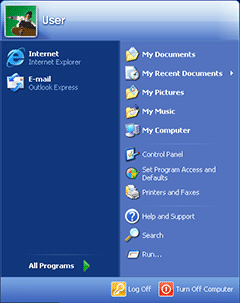
Updated start menu in Media Center Edition-exclusive Royale theme, now featuring two columns.
While retaining some similarities to previous versions, Windows XP's interface was overhauled with a new visual appearance, with an increased use of alpha compositing effects, drop shadows, and "visual styles", which completely changed the appearance of the operating system. The number of effects enabled is determined by the operating system based on the computer's processing power, and can be enabled or disabled on a case-by-case basis. XP also added ClearType, a new subpixel rendering system designed to improve the appearance of fonts on liquid-crystal displays. A new set of system icons was also introduced. The default wallpaper, Bliss, is a photo of a landscape in the Napa Valley outside Napa, California, with rolling green hills and a blue sky with stratocumulus and cirrus clouds.
The Start menu received its first major overhaul in XP, switching to a two-column layout with the ability to list, pin, and display frequently used applications, recently opened documents, and the traditional cascading "All Programs" menu. The taskbar can now group windows opened by a single application into one taskbar button, with a pop-up menu listing the individual windows. The notification area also hides "inactive" icons by default. A "common tasks" list was added, and Windows Explorer's sidebar was updated to use a new task-based design with lists of common actions; the tasks displayed are contextually relevant to the type of content in a folder (e.g., a folder with music displays offers to play all the files in the folder, or burn them to a CD).

.png)
The "task grouping" feature introduced in Windows XP showing both grouped and individual items
Fast user switching allows additional users to log into a Windows XP machine without existing users having to close their programs and log out. Although only one user at a time can use the console (i.e., monitor, keyboard, and mouse), previous users can resume their session once they regain control of the console. Service Pack 2 and Service Pack 3 also introduced new features to Windows XP post-release, including the Windows Security Center, Bluetooth support, Data Execution Prevention, Windows Firewall, and support for SDHC cards that are larger than 4 GB and up to 32 GB.
Infrastructure
Windows XP uses prefetching to improve startup and application launch times. It also became possible to revert the installation of an updated device driver, should the updated device driver produce undesirable results.
A copy protection system known as Windows Product Activation was introduced with Windows XP and its server counterpart, Windows Server 2003. All non-enterprise (Volume Licensing) Windows licenses must be tied to a unique ID generated using information from the computer hardware, transmitted either via the internet or a telephone hotline. If Windows is not activated within 30 days of installation, the OS will cease to function until it is activated. Windows also periodically verifies the hardware to check for changes. If significant hardware changes are detected, the activation is voided, and Windows must be reactivated.
Networking and internet functionality
Windows XP was originally bundled with Internet Explorer 6, Outlook Express 6, Windows Messenger, and MSN Explorer. New networking features were also added, including Internet Connection Firewall, Internet Connection Sharing integration with UPnP, NAT traversal APIs, Quality of Service features, IPv6 and Teredo tunneling, Background Intelligent Transfer Service, extended fax features, network bridging, peer-to-peer networking, support for most DSL modems, IEEE 802.11 (Wi-Fi) connections with auto configuration and roaming, TAPI, and networking over FireWire. Remote Assistance and Remote Desktop were also added, which allow users to connect to a computer running Windows XP from across a network or the Internet and access their applications, files, printers, and devices, or request help. Improvements were also made to IntelliMirror features such as Offline Files, roaming user profiles, and folder redirection.
Backward compatibility
To enable running software that targets or locks out specific versions of Windows, "Compatibility mode" was added. It allows pretending a selected earlier version of Windows to software, starting with Windows 95. This feature was first introduced in Windows 2000 Service Pack 2, released five months before the release of Windows XP, and was backported from prerelease Windows XP builds. Unlike with Windows XP, however, it was hidden from the operating system as it was not enabled by default and had to be manually activated through the Register Server utility. It was also only available to administrator users. Windows XP has this feature activated out of the box and also grants it to regular users.
Other features
- Improved application compatibility and shims compared to Windows 2000.
- DirectX 8.1, upgradeable to DirectX 9.0c
- Several new features in Windows Explorer, including task panes, thumbnails, and the option to view photos as a slideshow
- Improved imaging features such as Windows Picture and Fax Viewer
- Faster start-up (because of improved Prefetch), logon, logoff, hibernation, and application launch sequences.
- Numerous improvements to increase the system reliability, such as improved System Restore, Automated System Recovery, and driver reliability improvements through Device Driver Rollback.
- Hardware support improvements, such as FireWire 800, and improvements to multi-monitor support under the name "DualView"
- Fast user switching
- The ClearType font rendering mechanism, which is designed to improve text readability on liquid-crystal display (LCD) and similar monitors, especially laptops.
- Side-by-side assemblies and registration free COM
- General improvements to international support, such as more locales, languages, and scripts, Multilingual User Interface (MUI) support in Terminal Services, improved Input Method Editors, and National Language Support.
Removed features
- Main article: List of features removed in Windows XP
Some of the programs and features that were part of the previous versions of Windows did not make it to Windows XP. Various MS-DOS commands that were available in its Windows 9x predecessor were removed, as were the POSIX and OS/2 subsystems.
In networking, NetBEUI, NWLink, and NetDDE were deprecated and not installed by default. Plug-and-play incompatible communication devices (like modems and network interface cards) were no longer supported.
Later service packs, from Service Pack 2 onwards, would gradually remove features from Windows XP, such as support for TCP half-open connections, the Program Manager, and the Address bar toolbar option on the taskbar. The boot screens for all editions of Windows XP have also been unified by Service Pack 2 onwards, where the blue progress bar is used for all editions, including Home Edition (which previously used a green progress bar in Service Pack 1 and prior), and the SKU and copyright years on the boot screen were removed.
Editions
- Main article: Windows XP editions
Windows XP was released in two major editions at launch: Home Edition and Professional Edition. Both were made available at retail as pre-loaded software on new computers and as boxed copies. The Home Edition is explicitly intended for consumer use and removes certain advanced and enterprise-oriented features present on Professional Edition, such as the ability to join a Windows domain, Internet Information Services, and Multilingual User Interface. Windows 98 or Me can be upgraded to either Home Edition or Professional Edition and Windows NT 4.0 can only be upgraded to Professional Edition.
Two specialized variants of XP were introduced in 2002 for certain types of hardware, exclusively through OEM channels as pre-loaded software. Windows XP Media Center Edition, designed for high-end home theater PCs with TV tuners, offered expanded multimedia functionality, an electronic program guide, and digital video recorder support through the Windows Media Center application. Microsoft also unveiled Windows XP Tablet PC Edition, which contains additional pen input features and is optimized for mobile devices meeting its Tablet PC specifications. Two different 64-bit editions of XP were made available: Windows XP 64-bit Edition (intended for IA-64 or Itanium systems and discontinued in January 2005 due to IA-64 usage declining in favor of X86-64) and Windows XP Professional x64 Edition.
Microsoft also targeted emerging markets with the 2004 introduction of Windows XP Starter Edition, a special variant of Home Edition intended for low-cost PCs. The OS is primarily targeted at first-time computer owners, containing heavy localization (including wallpapers and screensavers incorporating images of local landmarks), and a "My Support" area which contains video tutorials on basic computing tasks. It also removes certain "complex" features, and does not allow users to run more than three applications at a time. After a pilot program in India and Thailand, Starter was released in other emerging markets throughout 2005. In 2006, Microsoft also unveiled the FlexGo initiative, which would also target emerging markets with subsidized PCs on a prepaid, subscription basis.
As a result of unfair competition lawsuits in Europe and South Korea, which both alleged that Microsoft had improperly leveraged its status in the PC market to favor its own bundled software, Microsoft was ordered to release special editions of XP in these markets that excluded certain applications. In March 2004, after the European Commission fined Microsoft €497 million (US$603 million), Microsoft was ordered to release "N" editions of XP that excluded Windows Media Player, encouraging users to pick and download their own media player software. As it was sold at the same price as the edition with Windows Media Player included, certain OEMs (such as Dell, which offered it for a short period, along with Hewlett-Packard, Lenovo, and Fujitsu Siemens) chose not to offer it. Consumer interest was minuscule, with roughly 1,500 units shipped to OEMs, and no reported sales to consumers. In December 2005, the Korean Fair Trade Commission ordered Microsoft to make available editions of Windows XP and Windows Server 2003 that do not contain Windows Media Player or Windows Messenger. The "K" and "KN" editions of Windows XP were released in August 2006, and are only available in English and Korean, and also contain links to third-party instant messenger and media player software.
Service packs
A service pack is a cumulative update package that is a superset of all updates, and even service packs, that have been released before it. Three service packs have been released for Windows XP.
Windows XP Service Pack 1 was released on September 9, 2002, and contained over 300 minor, post-RTM bug fixes, along with all security patches since the original release of XP. An update to SP1, called Service Pack 1a, was released on February 3, 2003, and was largely the same as SP1 except that the Microsoft Java Virtual Machine was excluded.
Windows XP Service Pack 2 was released on August 25, 2004, and included major security improvements, partial Bluetooth support, and Windows Security Center – an interface that provides a general overview of the system's security status, alongside other minor improvements.
Windows XP Service Pack 3 was released through different channels between April 29 and June 10, 2008, about a year after the release of Windows Vista, and about a year before the release of Windows 7. SP3 fixed over a thousand bugs, including security enhancements, as well as added other features.
Support lifecycle
Support for the original release of Windows XP (without a service pack) ended on August 30, 2005. Both Windows XP Service Pack 1 and 1a were retired on October 10, 2006, and both Windows 2000 and Windows XP SP2 reached their end of support on July 13, 2010. The company stopped general licensing of Windows XP to OEMs and terminated retail sales of the operating system on June 30, 2008, 17 months after the release of Windows Vista. However, an exception was announced on April 3, 2008, for OEMs producing what it defined as "ultra low-cost personal computers", particularly netbooks, until one year after the availability of Windows 7 on October 22, 2009. Analysts felt that the move was primarily intended to compete against Linux-based netbooks, although Microsoft's Kevin Hutz stated that the decision was due to apparent market demand for low-end computers with Windows.
Variants of Windows XP for embedded systems have different support policies: Windows XP Embedded SP3 and Windows Embedded for Point of Service SP3 were supported until January and April 2016, respectively. Windows Embedded Standard 2009, which was succeeded by Windows Embedded Standard 7, and Windows Embedded POSReady 2009, which was succeeded by Windows Embedded POSReady 7, were supported until January and April 2019, respectively. These updates, while intended for the embedded editions, could also be downloaded on standard Windows XP with a registry hack, which enabled unofficial patches until April 2019. However, Microsoft advised Windows XP users against installing these fixes, citing incompatibility issues.
End of support
On April 14, 2009, the main Windows XP exited mainstream support and entered the extended support phase. Microsoft continued to provide security updates every month for Windows XP; however, free technical support, warranty claims, and design changes were no longer offered. Extended support for the main version ended on April 8, 2014, over 12 years after the release of Windows XP; normally, Microsoft products have a support life cycle of only 10 years. Beyond the final security updates released on April 8 for the main version, no more security patches or support information are provided for XP free of charge; "critical patches" will still be created and made available only to customers subscribing to a paid "Custom Support" plan. As it is a Windows component, all versions of Internet Explorer for Windows XP also became unsupported.
In January 2014, it was estimated that more than 95% of the 3 million automated teller machines in the world were still running Windows XP (which largely replaced IBM's OS/2 as the predominant operating system on ATMs); ATMs have an average lifecycle of between seven and ten years, but some have had lifecycles as long as 15. Plans were being made by several ATM vendors and their customers to migrate to Windows 7-based systems over the course of 2014, while vendors have also considered the possibility of using Linux-based platforms in the future to give them more flexibility for support lifecycles, and the ATM Industry Association (ATMIA) has since endorsed Windows 10 as a further replacement. However, ATMs typically run the embedded variant of Windows XP, which was supported through January 2016. As of May 2017, around 60% of the 220,000 ATMs in India still run Windows XP.
Furthermore, at least 49% of all computers in China still ran XP at the beginning of 2014. These holdouts were influenced by several factors; prices of genuine copies of later versions of Windows in the country are high, while Ni Guangnan of the Chinese Academy of Sciences warned that Windows 8 could allegedly expose users to surveillance by the United States government, and the Chinese government banned the purchase of Windows 8 products for government use in May 2014 in protest of Microsoft's inability to provide "guaranteed" support. The government also had concerns that the impending end of support could affect its anti-piracy initiatives with Microsoft, as users would simply pirate newer versions rather than purchasing them legally. As such, government officials formally requested that Microsoft extend the support period for XP for these reasons. While Microsoft did not comply with their requests, a number of major Chinese software developers, such as Lenovo, Kingsoft, and Tencent, will provide free support and resources for Chinese users migrating from XP. Several governments, in particular those of the Netherlands and the United Kingdom, elected to negotiate "Custom Support" plans with Microsoft for their continued, internal use of Windows XP; the British government's deal lasted for a year, and also covered support for Office 2003 (which reached end-of-life the same day) and cost £5.5 million.
On March 8, 2014, Microsoft deployed an update for XP that, on the 8th of each month, displays a pop-up notification to remind users about the end of support; however, these notifications may be disabled by the user. Microsoft also partnered with Laplink to provide a special "express" version of its PCmover software to help users migrate files and settings from XP to a computer with a newer version of Windows.
Despite the approaching end of support of the main version, there were still notable holdouts that had not migrated past XP; many users elected to remain on XP because of the poor reception of Windows Vista, sales of newer PCs with newer versions of Windows declined because of the Great Recession and the effects of Vista, and deployments of new versions of Windows in enterprise environments require a large amount of planning, which includes testing applications for compatibility (especially those that are dependent on Internet Explorer 6, which is not compatible with newer versions of Windows). Major security software vendors (including Microsoft itself) planned to continue offering support and definitions for Windows XP past the end of support to varying extents, along with the developers of Google Chrome, Mozilla Firefox, and Opera web browsers; despite these measures, critics similarly argued that users should eventually migrate from XP to a supported platform.
The United States' Computer Emergency Readiness Team released an alert in March 2014 advising users of the impending end of support, and informing them that using XP after April 8 may prevent them from meeting US government information security requirements. Microsoft continued to provide Security Essentials virus definitions and updates for its Malicious Software Removal Tool (MSRT) for XP until July 14, 2015. As the end of extended support approached, Microsoft began to increasingly urge XP customers to migrate to newer versions such as Windows 7 or 8 in the interest of security, suggesting that attackers could reverse engineer security patches for newer versions of Windows and use them to target equivalent vulnerabilities in XP. Windows XP is remotely exploitable due to numerous security holes that were discovered after Microsoft stopped supporting it.
Similarly, specialized devices that run XP, particularly medical devices, must have any revisions to their software—even security updates for the underlying operating system—approved by relevant regulators before they can be released. For this reason, manufacturers often did not allow any updates to devices' operating systems, leaving them open to security exploits and malware.
Despite the end of support for the main version, Microsoft has released three emergency security updates for the operating system to patch major security vulnerabilities:
- A patch released in May 2014 to address recently discovered vulnerabilities in Internet Explorer 6 through 11 on all versions of Windows.
- A patch released in May 2017 to address a vulnerability that was being leveraged by the WannaCry ransomware attack.
- A patch released in May 2019 to address a critical code execution vulnerability in Remote Desktop Services, which can be exploited similarly to the WannaCry vulnerability.
Researchers reported in August 2019 that Windows 10 users may be at risk for "critical" system compromise because of design flaws of hardware device drivers from multiple providers. In the same month, computer experts reported that the BlueKeep security vulnerability, CVE-2019-0708, which potentially affects older unpatched Microsoft Windows versions via the program's Remote Desktop Protocol, allowing for the possibility of remote code execution, may now include related flaws, collectively named DejaBlue, affecting newer Windows versions (i.e., Windows 7 and all recent versions) as well. In addition, experts reported a Microsoft security vulnerability, CVE-2019-1162, based on legacy code involving Microsoft CTF and ctfmon (ctfmon.exe), that affects all Windows versions from the older Windows XP version to the most recent Windows 10 versions; a patch to correct the flaw is currently available.
Microsoft announced in July 2019 that the Microsoft Internet Games services on Windows XP and Windows Me would end on July 31, 2019 (and for Windows 7 on January 22, 2020).
In 2020, Microsoft announced that it would disable the Windows Update service for SHA-1 endpoints for older Windows versions. Since Windows XP did not get an update for SHA-2, Windows Update Services are no longer available on the OS as of late July 2020. As of March 2024, many of the old updates for Windows XP are available on the Microsoft Update Catalog. A third-party tool named Legacy Update allows previously released updates for Windows XP to be installed from the Update Catalog.
Hardware limitations
Physical memory limits
The maximum amount of RAM that Windows XP can support varies depending on the product edition and the processor architecture. All 32-bit editions of XP support up to 4 GB, except the Windows XP Starter edition, which supports up to 512 MB of RAM. The 64-bit editions support up to 128 GB.
Processor limits
The maximum number of physical processors that Windows XP supports is: 1 for Starter Edition, Home Edition, Media Center Edition, and Tablet PC Edition; and 2 for Professional.
The maximum number of logical processors that Windows XP supports is: 32 for 32-bit (x86-32) and 64 for 64-bit (x86-64).
Upgradeability
Several Windows XP components are upgradable to the latest versions, which include new versions introduced in later versions of Windows, and other major Microsoft applications are available. These latest versions for Windows XP include:
- ActiveSync 4.5
- DirectX 9.0c (June 7, 2010, Redistributable)
- Internet Explorer 8
- Windows Media Format Runtime and Windows Media Player 11
- Windows Virtual PC 2007 SP1
- .NET Framework 4.0
- Visual Studio 2010
- Windows Script Host 5.7
- Windows Installer 4.5
- Microsoft NetMeeting 3.02
- Windows Sidebar
- Windows Defender
- Office 2010 SP2
- The Windows Services for UNIX subsystem can be installed to allow certain Unix-based applications to run on the operating system.
Reception
Upon its release, Windows XP received mostly positive reviews from critics. Critics generally noted the increased performance of Windows XP, especially in comparison to Windows Me. They also reported that it had a more intuitive user interface, improved hardware support, and expanded multimedia capabilities. However, it was not free from criticism at the time of its release. Many users had criticized the new licensing model and the product activation system, as well as its many security flaws and zero-days upon its release. However, after Service Pack 2 was released, Windows XP received critical acclaim from many users and critics. It is estimated that over 400 million copies of Windows XP were sold during its first five years of availability, and that at least one billion copies were sold by April 2014.
Windows XP was an extremely popular operating system and remained popular even after the release of newer versions, particularly due to the poor reception of its successor, Windows Vista. Windows 7 finally took over XP's market share at the end of 2011 only to have it taken over by Windows 10 just 6 years later compared to XP's 10 years. Part of its popularity was also due to its extremely minimal system requirements; Windows XP can start on 32 MB of RAM (although 64 MB was the recommended minimum), and run smoothly with just 128 MB of RAM. Windows XP has the second most variants of any Microsoft operating system ever (just behind Windows 7). Windows XP was so popular that its default background, the 1996 photograph Bliss, became the most-viewed photograph in the world after the release of Windows XP.
According to web analytics data generated by Net Applications, Windows XP was the most widely used operating system until August 2012, when Windows 7 overtook it (later overtaken by Windows 10), while StatCounter indicates it happened almost a year earlier. In January 2014, Net Applications reported a market share of 29.23% for "desktop operating systems" for XP (when XP was introduced, there was no separate mobile category to track), while W3Schools reported a share of 11.0%.
As of September 2022, the majority of PCs in some countries (such as Armenia) still appeared to be running on Windows XP,[6] with just 0.39% of Windows PCs globally and 0.1% of all devices across all platforms running the operating system.[7]
Legacy
Windows XP is still considered by many to be the be the greatest operating system ever made. The failure of Vista caused many to revert back to XP. after the failure of windows 8, XP still had significant marketshare. The Windows XP startup and Error sound has also became an internet meme circulating around popular sites including YouTube and TikTok. Some people still use Windows XP to this day including the United States Military, Doctors, and numerous police forces because some features simply will not work on any newer Windows OS. The default wallpaper “Bliss” is by far the most viewed image on the internet. Windows XP was the first operating system that focused on user experience. The colorful interface was inviting, making computers more approachable for the average user.
Gallery


Graphics elements

References
- ↑ Windows XP - Microsoft Lifecycle, Microsoft Docs. 2014-04-08.
- ↑ Aide et Support - Windows Embedded POSReady 2009 (French), Microsoft Support. Archived 2014-10-10.
- ↑ Microsoft Announces Windows XP and Office XP, Microsoft. 2001-02-05.
- ↑ "Windows XP marketing tab to hit $1 billion". CNET. January 2, 2002. Archived from the original on February 1, 2014.
- ↑ Law, Gillian (October 15, 2001). "Microsoft changes XP slogan in wake of US attacks". Computerworld NZ. Archived from the original on September 5, 2015.
- ↑ Desktop Windows Version Market Share in Armenia – September 2022, StatCounter. 2022-09-30.
- ↑ Desktop Windows Version Market Share Worldwide, StatCounter. Archived 2019-04-20.
External links
- Windows XP at Microsoft (archived 2001-10-29)
- Windows XP support has ended at Microsoft Support
- Windows XP at Wikipedia
Microsoft Windows family
|
|---|
| Versions • Components • History |
| Original |
| DOS-based |
| Windows 1.0 • Windows 2.0 • Windows 2.1 (Windows/286 • Windows/386) • Windows 3.0 • Windows 3.1 |
| Windows 9x |
| Windows 95 • Windows 98 • Windows Me |
| Windows NT |
| Early versions |
| Windows NT 3.1 • Windows NT 3.5 • Windows NT 3.51 • Windows NT 4.0 • Windows 2000 |
| Client |
| Windows XP (development) • Windows Vista (editions • development) • Windows 7 (editions • development) • Windows 8 • Windows 10 • Windows 11 |
| Windows Server |
| Server 2003 • Server 2008 (2008 R2) • HPC Server 2008 • Home Server • Small Business Server • Essential Business Server • Windows Server 2012 • Windows Server 2016 • Windows Server 2019 • Windows Server 2022 |
| Specialized |
| Windows Embedded • Windows PE • Windows Fundamentals for Legacy PCs |
| Mobile |
| Windows Mobile • Windows Phone |
| Cancelled |
| Cairo • Nashville • Neptune • Odyssey • Windows 10X |
| Related |
| Metro • Midori • OS/2 • Windows Aero • Windows Setup • Windows XP themes • Microsoft Plus! |